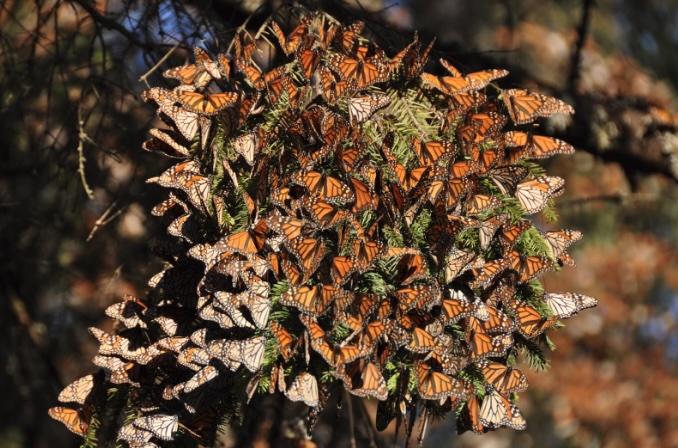
Migrating Monarchs in Mexico, photo courtesy of Dr.André Green
Monarch butterflies are beloved pollinators known for their charismatic wing patterns and affinity for milkweed. They are also known for their incredible annual migration. Each year, in late summer or fall, millions of monarch butterflies make the two-month-long journey from temperate regions in the US and Canada to specific southern wintering refuges in central Mexico. Incredibly, these migrating individuals have never been to their destination. Monarchs have a lifespan of less than a year, meaning they only make this great flight once. How these insects can return to the exact sites generation after generation is still a mystery. Another mystery lies in the differences between generations. Each season, one unique generation hatches at the end of summer and makes this flight. However, other generations born earlier in the season stay put, living their entire lives in the region where they were born. How these distinct phenotypes are built is still not fully understood.
Researchers in Dr.André Green’s lab in the Department of Ecology and Evolutionary Biology are looking to answer some of these questions: How do monarchs know how to get to Mexico? How do they know when it is time to migrate? How do the differences between the phenotypes of breeding and migrating generations develop?
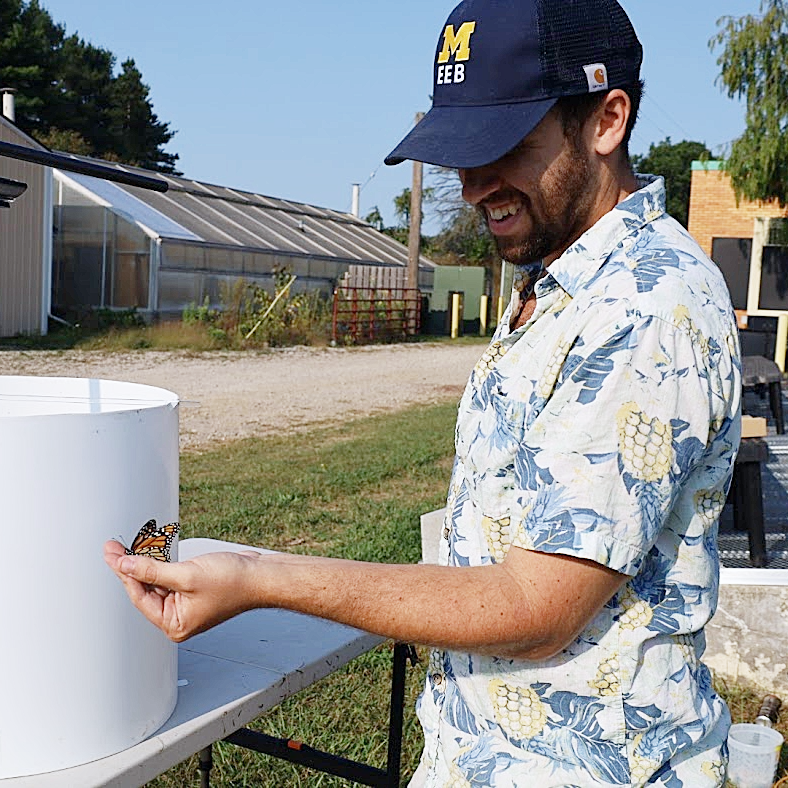
Sam Stratton, a 4th-year PhD candidate in the lab, says his fascination with this phenomenon motivates his research. “It's a really interesting question because monarchs are shorter-lived than the typical migrating species that you think of, like birds who travel similar long distances. These migrating species have parents to learn the migratory routes from. Yet, the monarch butterfly, which makes it from Michigan to Central Mexico, is doing it for the first time, and everyone around them is doing it for the first time as well. So how does that happen?”
These migratory behaviors can also be evolutionarily lost and gained from distinct populations of monarch butterflies. “I've been talking a lot about the monarchs here in Eastern North America, right in Michigan. But they're a very broadly distributed species. You see them across the Caribbean into South America, the Atlantic, and the Pacific. They all stem from these populations in Eastern North America that originated from Mexico and the Southern United States. As they've expanded that range, their ability to migrate has been lost or is non-present, but it's also been lost and regained in Australia. So there's this really cool ability to ask these evolutionary questions,” Sam explains.
Green Lab uses various methods, including behavior assays and molecular tools, to tug at some of the threads of these mysteries. Parts of this important work take place here on the grounds of the botanical gardens. In the laboratories and research fields at Matthaei Botanical Gardens, the Green Lab has conducted experiments in monarch behavior for over five years, breeding and raising monarchs in enclosures on-site each year. Currently, three projects are underway, each investigating a different aspect of monarch migration and behavior. While genomic methods and lab experiments can tell researchers a lot, Dr. Green emphasizes the importance of conducting experiments in naturalistic settings. “Although they're not free to do whatever they want, they are raised outdoors in the wild, with all of the variation that comes with that. We think that's critical to understanding exactly what the right cues are that are being perceived in order to make them migrate.”
One experiment, a long-term collaboration with the school of engineering, focuses on technology to electronically track individual monarchs during their migration. Another focuses on nectar rewards and how they influence monarch behavior. A third focuses on running directional flight tests, aiming to better understand what cues monarchs to begin flying south.
If the “flight test” is hard to picture, Stratton explains the procedure. “We attach the butterfly non-invasively by putting a little Band-Aid on its back to a string in the middle of a crossbar, allowing it to fly 360 degrees. With this string attached to it across a 10-minute trial, we can record how much a butterfly is flying, in what direction, and how directionally that butterfly is flying. We can get these individual metrics on their propensity to fly, if that flight is random or if it's like, ‘Okay, we're going southwest. It's fall. We're trying to get to Mexico.’”
While people may be familiar with monarchs as the poster child of pollinators, the goals of these researchers extend beyond planting native plant species. However, pollinator gardens are still part of the conversation.
Stratton clarifies that in his role as a researcher, his focus is not on making calls to action but on better informing those conservationists who are making those calls to action. “You know, plant local stuff, that's always good, local milkweed. But my research, specifically, is trying to understand, at the basic science level, what makes a migrant. Answering these mechanistic questions. For conservationists to make better-informed decisions, what are those calls to action? How is, say, environmental change influencing migratory patterns?”
Dr. Green has similar sentiments and shares some current contradictions within the world of monarch research. “I'm always a big fan of encouraging people to spend more time outside and pay more attention to their surroundings. Planting nectar resources and native milkweed is always beneficial. It's an interesting time in the monarch world, with a fight over what's actually happening with the population. It's actually a very complex question.”
While many pollinators, including the monarch, are threatened by global changes in climate and habitat, monarch populations may be in less of a decline than widely thought. While it is still unconstrained, Green explains that “Where we're settling, or rather what we’re recognizing, is that the really huge numbers that people saw decades ago were abnormally large, and so the steady state that we're coming back to is probably what it was historically, and so it's a big shift in how people think about that.”
The fear of plummeting monarch populations has led some enthusiasts to efforts that may have gotten out of hand. Green explains that fear of falling populations led to individuals raising thousands of monarchs and releasing them, which still has unknown effects on these populations. Others planted vast amounts of milkweed, but these were non-native species that are linked to a protozoan parasite that is harmful for local monarch communities. “It's a super fascinating case study on conservation advocacy and then the actual biology of the organism, how those things interact, and how that can change over time, and then how they influence each other. It's actually a fascinating story,” Green shares. Green is still an advocate for pollinator gardens done well. “I don't think that should take away from wanting to plant pollinator gardens. And those gardens don’t just benefit Monarchs; the thing that we should probably be promoting even more is that it's not just this one species.”