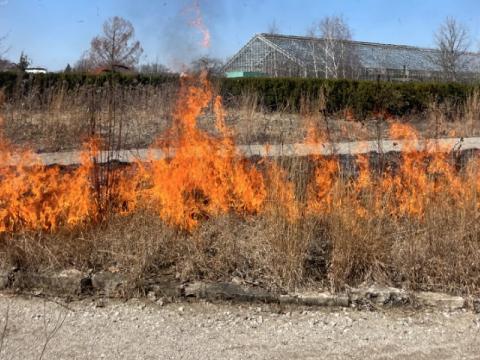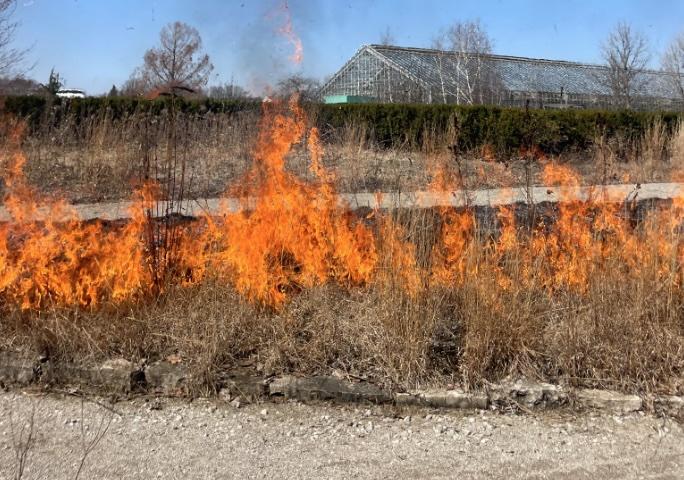
A prescribed fire in the Great Lakes Garden at Matthaei Botanical Gardens.
MBGNA is a hub for native species and beautiful landscapes. And this doesn’t happen by accident- the beauty and biodiversity on display are thanks in part to the intentional management of this land by our natural areas team. One important tool that our stewards use is prescribed fire.
Prescribed fire is the intentional introduction of a controlled blaze onto the landscape to help restore ecosystems. Fire has been used in Michigan for millennia by the Indigenous Anishinaabe, the first stewards of this land, for food production, defense, and land clearing. Current efforts, like Setting the Straits on Fire, are working to braid Indigenous ecological knowledge and storytelling with Western science to gather information on the historic use, frequency, and intensity of fires to better understand how the Anishinaabe managed this land with fire. They presented here at Matthaei in February, sharing their results about the reconstruction of fire history in the homeland of the Little Traverse Bay Bands of Odawa Indians.
At MBGNA today, we use fire to control non-native plants and promote biodiversity, often in tandem with manual clearing of woody shrubs.
Jeff Plakke, our Natural Areas Lead, has been conducting prescribed burns on MBGNA’s landscapes since the early 2000s. “We find ourselves here now, stewards of these lands that were once stewarded by people who regularly used fire, and it was a critical tool for them in their stewardship of the land and in their agriculture,” he shared.
Many native grasses and flowering plants depend on fire for regeneration, evolving from centuries of grassland burning set by both humans and lightning strikes throughout the prairies of the Midwest. Each fire removes accumulated thatch, or dead plant material on the surface. Prescribed burns help to reduce excess woody plant growth, add nutrients from ash, and warm the soil, encouraging seed germination. Our land stewards burn units of land in the prairie and woodland settings at MBGNA on a three-year cycle, allowing the ecosystems years in between to recover.
As Steven Parrish, Natural Areas Specialist, shares, “Prescribed fire can really boost those flowering plants, which are the basis for the insect population, which then brings the birds. So it's a really fundamental tool to use to promote species diversity, to promote the species that we find valuable as pollinators and for seed production.”
Prescribed Fire at MBGNA
In the late 1980s and early 1990s, land managers at MBGNA introduced prescribed fire as an ecological tool for restoring Dow Prairie at Nichols Arboretum and the surrounding woodlands. Since then, the process has spread to the botanical gardens, and units of land across both properties are intentionally managed on a three-year rotation.
The burn procedure at MBGNA involves a lot of planning- coordinating weather conditions, burn breaks, smoke direction, and season. As Parrish explains, “We figure out where we want to burn, and then we write a burn prescription that includes maps, acreage, ideal wind direction, the fire officials we're contacting, and what dates we're looking at. The fire officials are generally supportive of that because they know that it's actually reducing the fire potential for unintentional fires in some of these areas.”
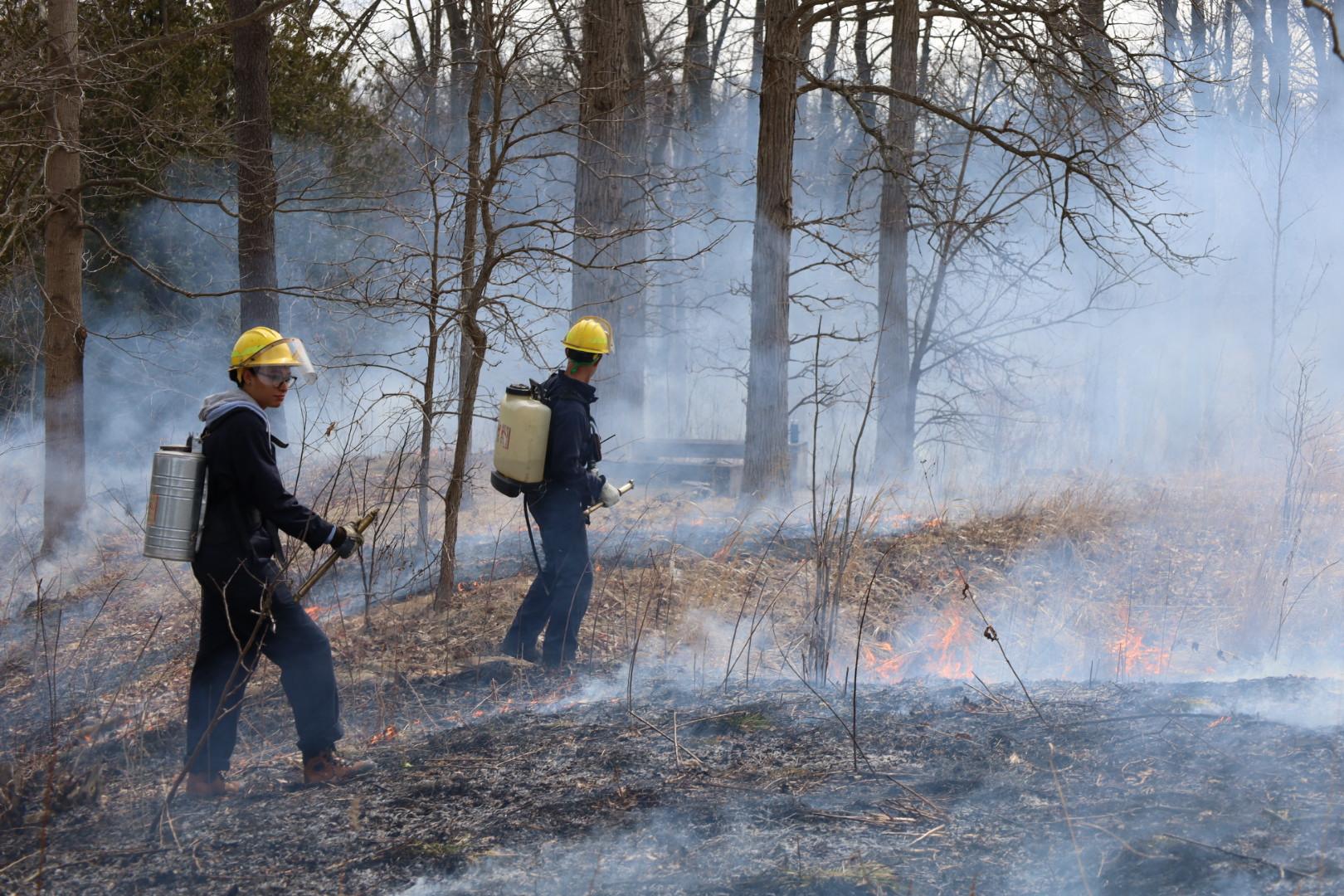
Before the fire begins, the burn team ensures that the burn unit has solid boundaries: bodies of water, roads, trails, or even low-cut grass that prevent the spread of fire outside of the desired parcel. Then, staff and volunteers work together to use drip torches to ignite dry thatch at the edge of the burn unit. They use rakes to methodically spread fire throughout the unit, burning into the wind to reduce headwinds that could make the fire burn hotter, faster, and be more difficult to control. Everyone wears protective suits, helmets, and goggles, and a water backpack with a hose to control unwanted blazes. They also use “flappers,” large rubber rectangles that can tamp out a small blaze.
Fire RX: The Prescribed Fire Impact
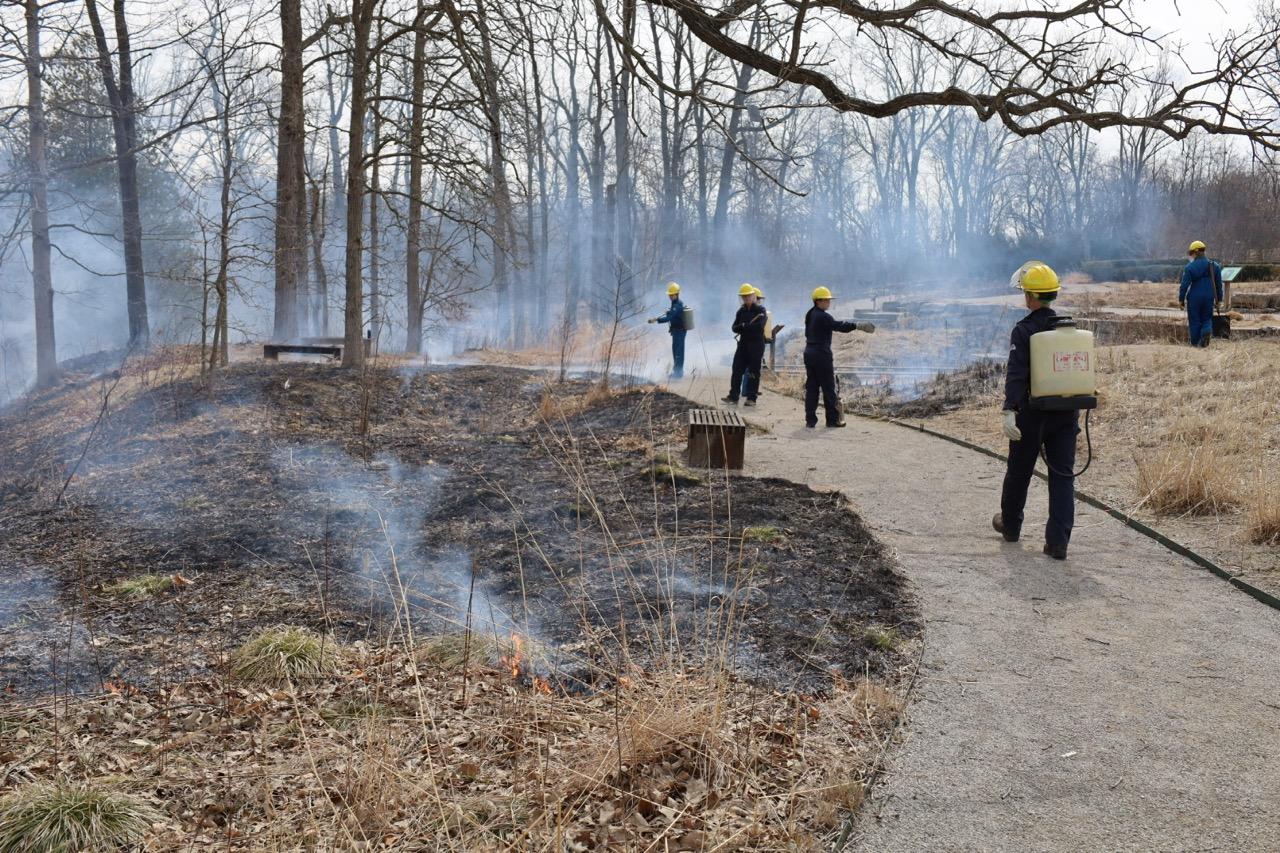
After a burn, the landscape can look startling, a stark expanse of scorched earth. But especially for the early season burns in spring, this landscape is quickly transformed. “I explain to visitors walking by while we're doing the burn that it will reinvigorate this area,” Plakke explains. “All these plants will come back really vigorously, in just a few more weeks. Some people think it's killing a lot of these plants, but really it’s just giving them a haircut. It's burning off the dead and dying thatch, so everything comes back even stronger.
Over their years introducing fire repeatedly to the landscapes at MBGNA, both Plakke and Parrish have observed the firsthand impact of returning fire to these landscapes. “What we see in the Oak Hickory woods that have not had fire in a long time is that there's not a lot of herbaceous plants left. By cutting down the non-native woodies and removing them, and then bringing fire through those systems, we see a lot of the sedges and wildflowers, and even some rare species that we haven't seen before, coming back,” Plakke shares. “So it's really exciting to see that reinvigoration of that layer of the vegetation community, which is so important in those Oak Hickory Woods, savannas, and prairies-it's where a lot of the diversity lies, ”Parrish added. “It’s fun to see the less common plants start to come back when we're doing proper land management.”
Fire is also a great on-ramp for future conservationists, Plakke explains. “It can encourage other people to get into land stewardship and learn more about biodiversity and fire ecology. I think that's really where the big picture questions and big picture answers come in for the future of humans on Earth. We have to remember our roots; we have to get engaged and take care of our lands and all the species that are part of the community that we're a part of.”
Fighting Fire with Fire: Prescribed Fire and Wildfire Prevention
With increasing wildfires under climate change, intentionally bringing fire into our native ecosystems can raise eyebrows. But the two events aren’t unrelated. Fire suppression can lead to an overabundance of fuel stores that, when lit, spread further and faster than landscapes periodically exposed to fire. As Parrish explains, “Smoky the Bear was problematic because when fire suppression started, that's when we have more of these catastrophic fires, where the fuel load builds up and gets way hotter than you could ever want it for a low-grade controlled fire, rather than this. So you know, if we had kept kind of a burn regime in place, we could have eliminated a lot of these problems.”
Learn More:
Prescribed Fire Festival: The Michigan Prescribed Fire Council and Matthaei Botanical Gardens are teaming up to launch Michigan’s first Prescribed Fire Festival. This family-friendly event invites people of all ages to learn about the role of prescribed fire in maintaining healthy ecosystems, supporting biodiversity, and reducing wildfire risk. https://mbgna.umich.edu/event/prescribed-fire-festival
Get involved! If you are interested in helping out on a burn,
Visit the Michigan Prescribed Fire Council web page to find resources for burn practitioners, contractors, or if you wish to conduct a prescribed burn on your own property: