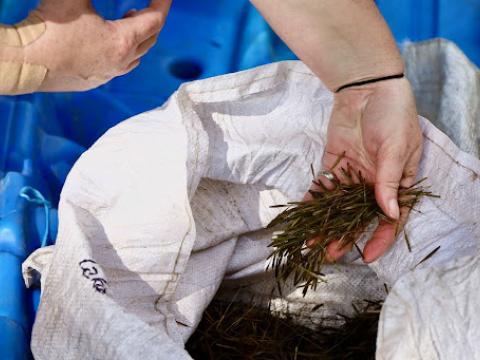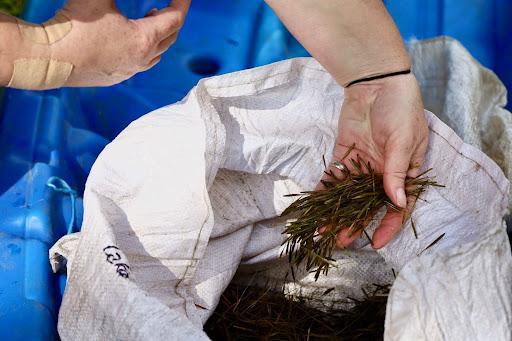
On September 24th, Indigenous community members, U-M faculty and students, and MBGNA staff gathered on the banks of Willow Pond at Matthaei Botanical Gardens to reseed Mnomen (Manoomin, Miinomin, Wild Rice) into the pond for the third season.
Mnomen is Michiganʻs State Grain, a traditional Anishinaabek food, and a culturally significant plant. Historical records show that Mnomen once grew in the area where Matthaei Botanical Gardens now stands. Growing tall in exclosures in Willow Pond, Mnomen has returned to the waters of MBGNA through a collaborative partnership that braids Indigenous knowledge and stewardship with Western science, made possible through Indigenous partnership and cross- campus and cross-community collaboration.
Indigenous to Michigan, Mnomen grows in small lakes and rivers, and was once abundant throughout the Great Lakes region. Today, Mnomen populations have been significantly reduced through the displacement of Anishinaabek people from their homelands, ecological destruction, shrinking wetland habitat, and climate change, particularly here in Southeast Michigan. Now, Mnomen survives in small pockets, at only a fraction of its original abundance. Indigenous stewards are working across the state to restore Mnomen to Michigan’s waterways.
The Willow Pond restoration project first began through the master’s work of SEAS student Sam Stokes. When Stokes met respected Manoomin knowledge holder and caretaker Roger LaBine of the Lac Vieux Desert Band of Lake Superior Chippewa Indians at a rice camp, this meeting precipitated a collaboration to assess the feasibility of Mnomen restoration on U-M land. In 2020, the Manoomin Initiative grew, receiving funding from the Graham Sustainability Institute to identify the best sites for Mnomen restoration from ten U-M properties. This initiative included Anishinaabek community members, U-M faculty, MBGNA staff, and allies at other Michigan universities. Due to its accessibility and visibility, among other factors, the study found Willow Pond to be the most viable site.
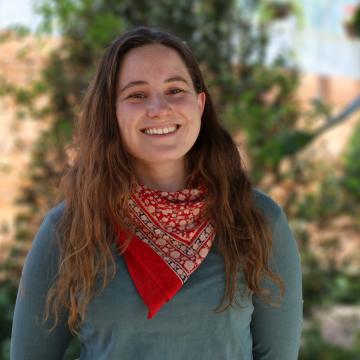
In 2022, Dr.Selena Smith, an Associate Professor in Earth & Environmental Sciences and Program in the Environment, led a team to secure an LSA grant, “Meeting the Mnomen,” to continue this work. The grant describes how Mnomen offers “an opportunity to restore relationships between UM and Tribes, people and land; to reimagine research across spheres of knowledge; and contribute to creating a more just and equitable future.” As Smith, a registered citizen of the Métis Nation of Ontario, reclaims her heritage, she works to support projects here in the Great Lakes Region that uplift Indigenous ways of knowing. “For me personally, this has been important in giving me a bridge between my heritage and my scientific training, and my first major role in an Indigenous Science-framed project,” Smith shared. “More broadly, it has been significant to the community around here. A lot of students have found it really valuable to actually interact with Mnomen or work with this plant, or contribute in some way to the project if they care deeply about the environment, and we're finding more and more students recognize how much they have not been taught about Michigan's original people, and so they're eager to learn and to try and be better allies.”
Central to this work is the understanding of Indigenous knowledgeways as equal to Western science. With this view, Mnomen is not seen as an inanimate species, but as a spiritually active treasured relative. “Mnomen is a sacred relative, kin in the most profound sense, and in her native wetland habitats, the destination in one of humanity's great epics - the migration of the Anishinaabek peoples to the waters and lands of the Great Lakes. Restoration is not “just” a scientific activity, but deeply resonates through all kinship networks of the sentient world,” Smith shared. “Willow Pond serves as a teacher and “living lab” for us to braid together Indigenous and Western sciences. This is a human-made pond that offers important habitat to a variety of more-than-human relatives.”
The Ice Out Ceremony
In early Spring 2023, an Ice Out ceremony invited Mnomen home to Willow Pond. As elder Roger LaBine shares, “Ice Out" is the time when Nibi (the water bodies) open up; our non-human relatives wake up to receive the gift of sunlight from Grandfather Giizhis / Mishomis to begin another life cycle. This is the time our relatives will accept our petition, and they will hear our request for their assistance to gift and bless us with the sacred Manoomin.” Manoomin seeds were first planted in the Spring of 2024, and took to Willow Pond that year. “We have to introduce Mnomen to the community, just like when we meet somebody. We had a pipe ceremony, we had a prayer, and we asked all of our relatives to welcome those seeds that we were going to bring. We asked Mother Earth. We asked the wind. We asked everybody to bless that we were going to be returning in the fall with some seed and try to make a home for wild rice. When I look at those two plots out there, it wasn't a bad decision. Our assessment was correct,” LaBine shared while visiting Willow Pond earlier this season. This year marks the third year that Mnomen has flowered on Willow Pond. “While we cannot know if she will stay long-term and re-establish a population, this is an intentional act to bring back reciprocity and responsibility in how we interact with these and other ecosystems,” Smith shared.
Water Quality Monitoring for Mnomen
Mnomen thrives in clean, cool, flowing water in lakes and rivers with silty, nutrient-rich bottoms. In many ways, Willow Pond is well suited to host Mnomen. The human-made pond flows into Fleming Creek, providing a subtle current, and the silty bottom is rich with organic material.
As part of Mnomen stewardship, Smith and her team have been monitoring water quality in the pond and surrounding ecosystem. This testing has revealed that the water has high salinity, likely from road-salt runoff. Sulfate levels, while below EPA safety levels, are higher than what Mnomen has been known to tolerate. Despite this, two stands of Mnomen are thriving in the pond. “I have a colleague who always says plants do what they want,” Smith shared. “And I feel like Mnomen still has some things to teach us about how flexible she is in some of these systems.”
Indeed, Mnomen has much to teach. Mnomenʻs presence in Willow Pond has led to changes in the management of Willow Pond, shifting away from herbicide to manual removal. The pond has seen encroachment from non-native cattails, which are now cleared manually to ensure the water quality is sustained for Mnomen and, in turn, all the other relatives who call Willow Pond home.
And the cleared cattails are not only composted. Native American Student Association (NASA) students have worked with Smith to turn this abundance of fibrous plant material into craft. “One thing that we've started doing is again rebuilding those relationships with cattail, which is also a relative with a lot of gifts. We can see about how to keep that balance, but in a way that is still relational, and harvesting the cattails with intention to practice some other traditional skills, making baskets, or maybe less traditional things like making paper, that we can still use other gifts rather than just seeing the plant as something to get rid of”
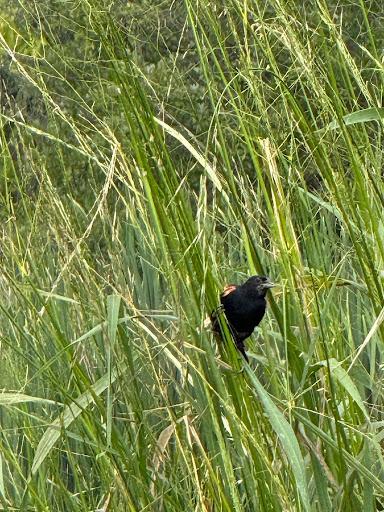
Us humans are not the only ones excited to see Mnomen return to Willow Pond. Many creatures have been seen interacting with Mnomen on the pond. In the first year, Muskrats came and nibbled so much that the exclosures were reinforced underwater to give the plant time to establish. Asiginaak, or red-winged blackbirds, have been seen landing on the stalks to eat the seeds. “This project wouldn't have been possible without relationships between people at different levels, between the institution and the tribes. Building those relationships with Mnomen for us as people, but also these other relatives that seem excited to see her back, and I think that's something that's ongoing, and that's led us to think about some of the other parts of the pond in different ways,” Smith shared.
LaBine echoed this same message, sharing that “It’s not just for us, but it's for all that wildlife, all of our non-human relatives, deer, moose, a lot of other animals that also like wild rice, and so it's not what a lot of people believe. It’s not mine; it's ours.”
Interpretation
Willow Pond was chosen as a site to welcome Mnomen home in part because of its visibility. Interpretation has always been a key facet of this project. In the summer of 2026, a set of interpretive signs was installed around the pond, introducing visitors to both the Anishnaabek and Mnomen. These signs were made possible through collaboration with Eric Hemenway, the humanities manager at the School of Environment and Sustainability. In this role, he focuses on Indigenous storytelling of the Anishnaabek, the Indigenous People of Michigan. New to the role this year, he brought his 20 years of experience working for the Little Traverse Bay Band of Odawa Indians in their archives, creating exhibits, signage, curricula, and public programs. He incorporated critical context and knowledge of the Anishnaabek into the signs that now live around Willow Pond. “My greatest hopes would be, you know, a fifth grader comes in and says, 'I did not know any of this. I want to know more. Where do I learn more? How do I use this information? This information is challenging to me, but I'm not shying away from the challenge of what I'm seeing. And now I know who the first people to this land are, and not in the past tense.” He shared.
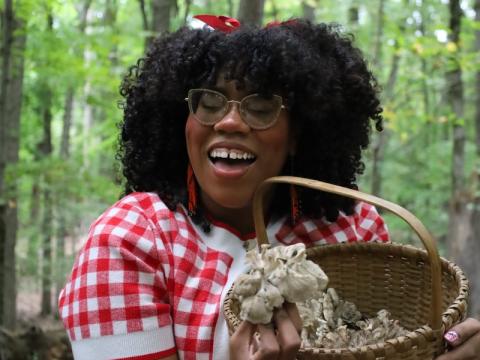
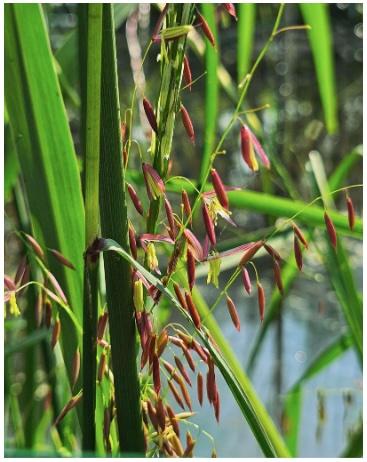
Tonya Sanchez is a U-M student finishing a second degree in American Culture, focused on Native American studies. She connected with the project in 2023 and has helped with field and lab work, and worked with Smith on first drafts of the interpretation for Willow Pond. Her photos of Mnomen in flower can be found on the installed interpretive panels around the pond. “I'm excited for this project to hopefully open more doors,” she shared. “These signs are in spaces where people are going to come and visit, and it gives them opportunities to understand more about the first people who stewarded this land, and how even a person who might be non-Indigenous can be part of the work of being in good relationship with the land.”
Looking to the Future
The idea is that this project will help create a pool for data aggregation to be able to take a regional look at how water quality ranges impact Mnomen's growth, especially as Mnomen continues to be further threatened under climate change. “Even if we can fix a lot of water quality issues and our relationship to the plant, this is a part of the state that's still going to get hotter than up north. It would be a shame if Manoomin never grew here again. So we’re just trying to repair those past harms that were done to the broader environment,” Smith explained.
The work is part of Meet the Mnomen, a collaborative project bringing together Indigenous knowledge, ecological research, and public learning to explore Mnomen and its connections to people, place, and freshwater ecosystems that was funded in part by the College of Literature, Science, and Arts. The guiding concept is framed by the Manoomin Stewardship Plan - We All Live Together in a Good Way.