As the garden goes dormant in September and October, it is one of the best times to divide peonies in Michigan.
Division is a form of propagation that results in genetically identical plants. This makes division an excellent technique to increase the number of a favorite peony selection for yourself or to share. Division may also be a good way to move peonies out of shaded or crowded sections of your garden.
What's Going on Down There?
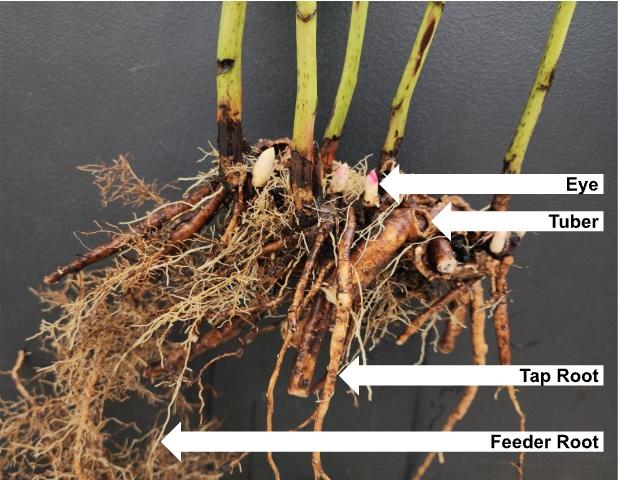
Digging and dividing peonies is a great opportunity to observe the anatomy of peony roots (Fig. 1). Peonies have underground modified stems called tubers that store energy and water. The tubers also produce eyes, which are the buds where next year's vegetation and flowers sprout from. Tap roots and fibrous feeder roots extend from the tuber to supply water and nutrients while anchoring the peony in place.
Preparation:
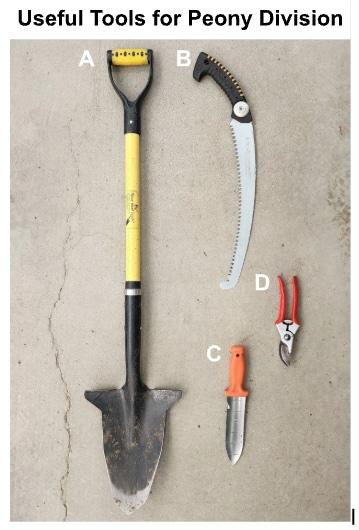
To reduce stress on the peony when dividing, gather your tools (Fig. 2) and know where you would like to plant your divisions in advance.
Tools:
Garden spades are well suited to digging up the peony. When dividing herbaceous peony species, pruners will be able to cut through their tubers. However, in overcrowded herbaceous specimens or intersectional hybrids, a hand saw or serrated soil knife may be more appropriate for dense or woody root systems.
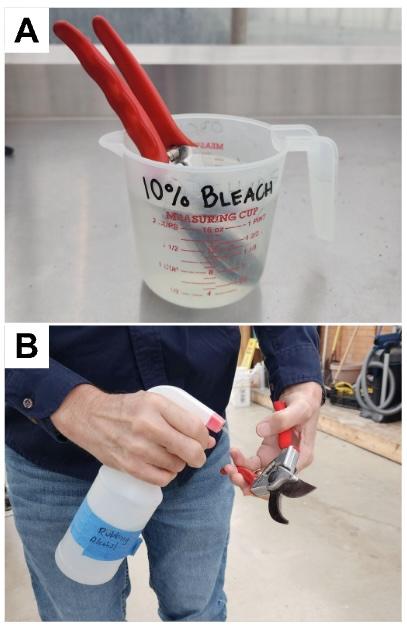
When working with more than one plant or site, it is important to sanitize tools to limit the spread of disease. Common sanitizing solutions you can mix at home are 10% bleach or 70% rubbing alcohol. When sanitizing in a 10% bleach solution, ensure it is in contact with the tool for 10 minutes and that any excess bleach is cleaned off since it can be corrosive to metal (Fig. 3A). Use a 10% bleach solution within 2 hours after mixing since it loses its disinfecting power (Steil 2026). A 70% rubbing alcohol solution may be easier to use as it disinfects tools on contact, is noncorrosive, and can remain effective for approximately 1 year after opening (Fig. 3B). Properly label all sanitizing solutions and avoid using cups or glasses that could lead to accidental ingestion
Site:
Fall is not only a great time to divide peonies, but a great time to transplant peony divisions. Select a site with full sun and well-draining, alkaline soil. If you choose to amend soil at planting, utilize a low-nitrogen fertilizer. Too much nitrogen will promote excess foliage and can inhibit blooming. Planting so the eyes are 1 to 2 inches deep is critical; peonies often fail to bloom if planted too deep.
Fall transplants are subject to freeze-thaw cycles. Rapid freeze-thaw cycles expand and contract the soil, which pushes the tubers to the soil surface, making the peony vulnerable to drying out. Mulching transplants acts as a blanket and can reduce the risk of frost heaving.
If you do not have a site selected at transplant, peony tubers can be stored bare root or in containers. Make sure tubers are stored in a cool (35-45℉) location. Check tubers periodically for signs of rot or desiccation.
Methods:
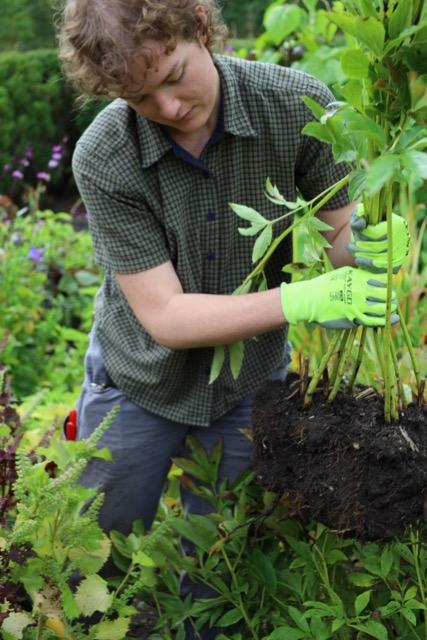
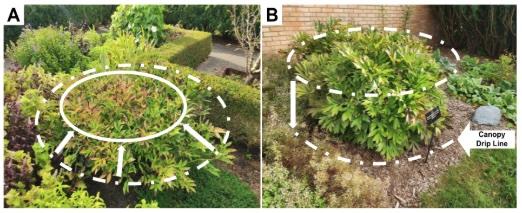
Two common methods for dividing herbaceous peonies are the pie-slice method and the whole-plant method. The pie-slice method is well suited for when you need to control the size of your peony or propagate a small amount (Fig. 4A). The whole-plant method is ideal for when you want to relocate your peony or propagate a large amount of plant material (Fig. 4B). It is easier to divide peonies before removing foliage in the fall since the leaves can act as a “handle” to move the plant with.
Pie-slice Method:
- Sanitize tools.
- With a spade, dig out a section of your peony you would like to remove. Make sure you dig down 8-in or deeper to get as much root mass as possible.
- Continue to loosen the section and then lift the “pie-slice” out of the ground.
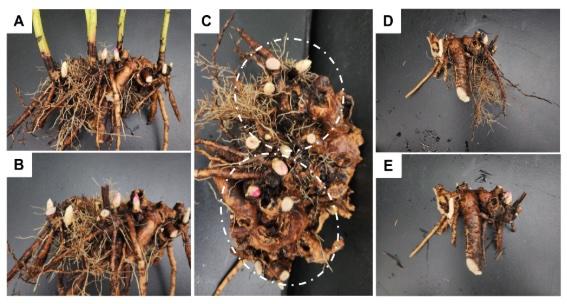
- Shake the soil from the roots. Spray remaining soil with a hose to further expose the roots and tubers (Fig. 5A).
- Remove and properly dispose of foliage (Fig. 5B).
- Identify 3 to 5 eyed sections (Fig. 5C). Divide sections with clean cuts (Fig. 5D).
- Remove weak or broken roots and leave only large, healthy roots about 6 to 8-in long (Fig. 5E). Peony transplants will grow more vigorously from having their roots trimmed.
Whole-Plant Method:
- Sanitize tools.
- With a spade, dig a circular trench around the canopy drip line.
- Dig around the trench again, now positioning the spade at a 45° angle under the plant.
- Gently begin to lift the plant out of the soil. If the peony is still stuck in the ground, dig under the peony again and pry with the spade.
- The plant will come out in one or more pieces. Ensure all the peony tubers have been removed from the ground, otherwise a peony may regrow there
- Shake the soil from the roots. Spray remaining soil with a hose to further expose the roots and tubers (Fig. 5A).
- Remove and properly dispose of foliage (Fig. 5B).
- Identify 3 to 5 eyed sections (Fig. 5C). Divide sections with clean cuts (Fig. 5D).
- Remove weak or broken roots and leave only large, healthy roots about 6 to 8-in long (Fig. 5E). Peony transplants will grow more vigorously from having their roots trimmed.
Conclusion:
Fall is an ideal time to divide your peonies, offering a reliable way to spread the joy of peonies across your garden or with your friends. Remember:
To sanitize your tools between sites or plants to reduce the spread of disease. An ounce of prevention is worth a pound of cure.
To cut back to strong roots and include 3 to 5 eyes for a vigorous new plant.
It may take up to 3 years for these divisions to establish in the garden and bloom. Planting too deep or excess nitrogen fertilizing can also inhibit blooming.
Works Cited:
Steil, A. 2026. How do I sanitize my pruning shears?. https://yardandgarden.extension.iastate.edu/faq/how-do-i-sanitize-my-pruning-shears. [accessed 30 Sept 2026].