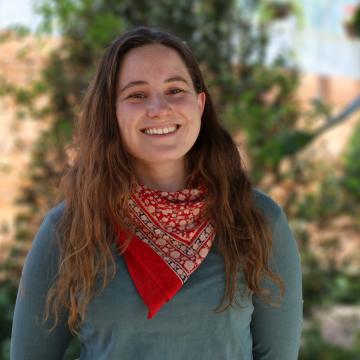
Is ignorance bliss? Or does it pay to be smart? PhD candidate Joseph Caldwell is exploring these questions in two native paper wasp species, Polistes metricus and Polistes fuscatus, on-site in research fields at MBG. Caldwell works in the Tibbetts Lab in the Department of Ecology and Evolutionary Biology, where he studies animal behavior, learning, and cognitive evolution.
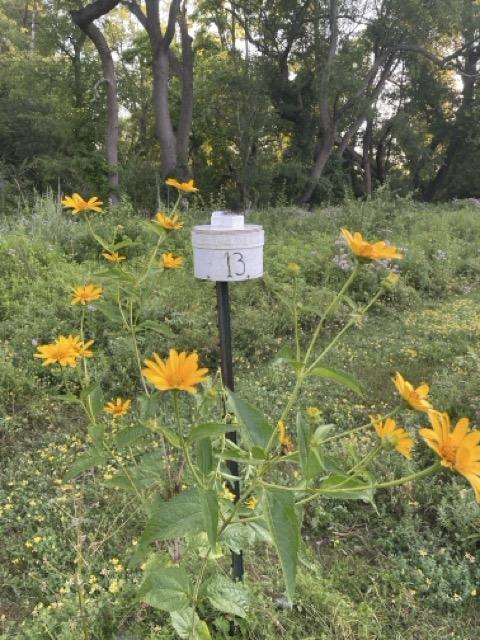
To recruit wasps for this experiment, he utilized established nest boxes at MBG, which are home to many wild paper wasps. Wild wasps colonized them on their own, building their signature paper umbrella-shaped nests in which they lay their eggs and live out their lives. “Once individuals have established their nests in my boxes, I mark the nest-founding queens with paint to identify each individual, so I know who everyone is and where they live,” Caldwell explains.
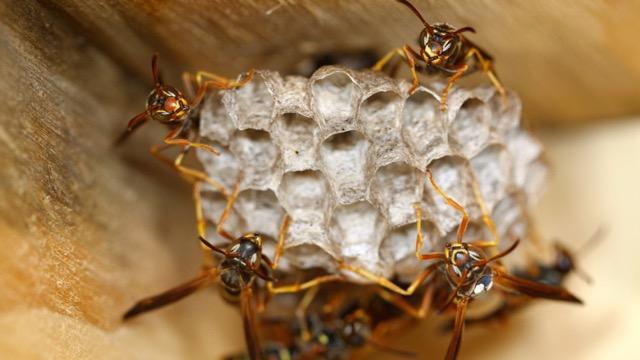
By setting up residence in these convenient nest boxes, the wasps within become research participants. Caldwell’s research project tracks cognition, behavior, and fitness of these wasps across multiple generations. This involves periodic wasp field trips to the lab, where Caldwell tests how “smart” they are. He gives the wasps a series of cognitive tests to see how good they are at solving a variety of learning and memory problems.
“In plain English, what I want to know is: do smart moms have smart babies? Do those babies have smart babies? And are smart individuals more successful? You can say the same thing about being dumb too,” Caldwell explains.
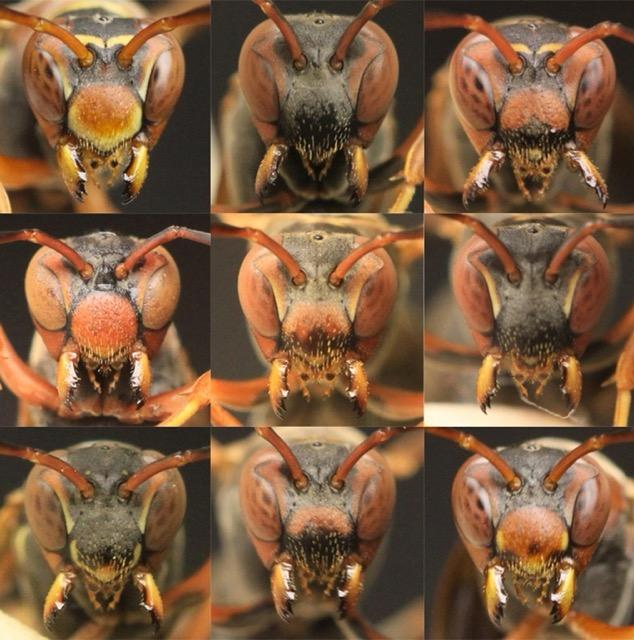
Polistes fascatus is a study species of interest due to its unique ability to recognize individual wasp faces. “Just like you and I, their faces are totally different,” Caldwell explains. “They can use the variation in facial patterns to recognize each other, which is amazing. Not only that, they can use their face learning ability to recall social information about each other too. In this way, they can remember different social aspects about each individual in the colony, and use that social information to their benefit.
Once finished with the cognitive experiments in the lab, the wasps are returned to their nest boxes in the gardens where they live the rest of their lives freely. From their performance on the tests in the lab, each wasp is given a cognitive “profile” that Caldwell can use in tandem with behavioral and fitness data. Their nests are monitored with cameras to track individual behavior and lifetime success. The cameras record the nests at intervals to capture social interactions and foraging behaviors. “Successful wasps build a big nest and have lots of babies. An unsuccessful wasp has no babies and/or dies. So, we're measuring cognition, behavior, and fitness of individuals over their entire lifetime.”
Paper wasps are philopatric, meaning they return to near their natal
nest sites over generations. This makes them a prime study species, allowing researchers to track them across multiple generations. “This can potentially give a snapshot in time of cognitive evolution,” Caldwell explains. “If we can see that these measures of intelligence are heritable, it is very possible that these traits can evolve.” This is the second year of the experiment, so Caldwell is currently tracking the first generation of offspring involved in the project. “Are individuals that are good at these cognitive tests more successful? We have hypotheses, but we don't actually know what we're going to see over multiple generations.”
This type of research is novel for a field that, for a long time, solely focused on cognition at the species level. “It’s an amazing thing that we see so much individual variation (in cognition), and that individual variation is the raw material upon which selection can act,” Caldwell explained. “Selection isn't acting on populations; it's acting on individual phenotypes. So if we have a wide variety of individual cognitive phenotypes, it's therefore plausible to hypothesize that it can evolve through natural selection. …we see so much variation, and that's sort of the driver of my work.”
Through this research, Caldwell has become a self-proclaimed bug guy. But this wasn't always the case. “When I started studying animal behavior. I was probably more attracted to the charismatic animals like tigers and bears and lions and elephants. I just loved animals in general, but I was quickly converted once I realized how intelligent these creatures actually are, and all the amazing things that they do.”
Caldwell is hopeful that others will join him in this fascination, and “flip on the bug filter” to start noticing the little crawling critters around us. “There's an amazing diversity of things going on in the insect world. If you zoom in and you turn on the bug filter, you're going to see this incredible diversity.”