As Matthaei Botanical Gardens and Nichols Arboretum’s Director, I have the opportunity and honor to help steward the W.E. Upjohn Peony Garden’s present and future. The W.E. Upjohn Peony Garden celebrates its 100th anniversary in 2022 and with that comes a question that I am often asked: what do you do with a historic peony garden at a leading public research university? to be honest, it’s a question I truly love answering.
The W.E. Upjohn Peony Garden enjoys a long, meaningful history. But its real legacy is one of catalytic impact, which I tend to think about in four categories: innovative research, science-based geopolitical discourse, horticultural practice and artistry, and community-making.
There are a number of interdisciplinary research endeavors that are only possible because this garden is here at the University of Michigan. They regularly take the form of furthering unique faculty-led research like “Pee for the Peonies,” or student-led projects like last summer’s efforts toward a Feminist critique of the horticulture industry. The garden also serves as the living laboratory for ongoing phytogenetic and virological research led by MBGNA Senior Curator Dr. David Michener and Visiting Research Scientist Nastya Vlasava. Their research is only possible because of the long-standing sister-garden relationship MBGNA proudly shares with the Central Botanical Garden of the National Academy of Sciences of Belarus. Through this work, the W.E. Upjohn Peony Garden actively provides opportunities for peaceful scientific relationships and discovery in a time of deep geopolitical destabilization.
The W.E. Upjohn Peony Garden also catalyzes something rather obvious, but perhaps overlooked: horticultural practice and artistry. In my time as Director, I’ve deepened my appreciation for horticultural practice as a hybrid between scientific knowledge and something more akin to many arts practices: embodied knowledge. This kind of knowledge is held in both the mind and the body and, like Dance or Theatre, provides immersive experiences for audiences through mastery over gesture and movement. The ongoing practice and study of horticulture expands the discipline and makes real, meaningful impact.
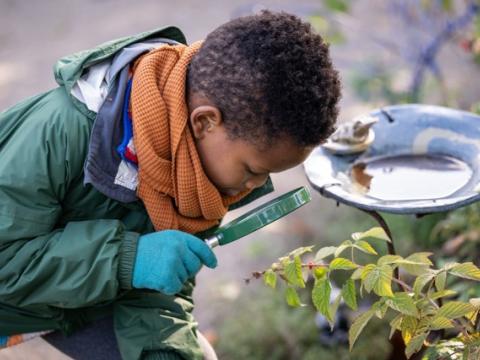
Which brings me to the last component of the role of a historic peony garden at a leading public research university. The W.E. Upjohn Peony Garden has become a cornerstone of the greater Ann Arbor and regional community; more than 300,000 visitors pass through it annually, and bloom time is truly something to behold. More than that, however, its positioning and physical location have begun to frame my experience in ways I hadn’t anticipated. When I’m in the Peony Garden I am flanked on one side by the Von Voigtlander Women’s Hospital, where so many of our community members start their lives. On the other side is Ann Arbor’s historic Forest Hills Cemetery. In between those two symbols of the beginning and end of life is the W.E. Upjohn Peony Garden, filled to the brim with all of the joy, drama, and complexity life has to offer. Just in my 14 months as Director I’ve witnessed a wedding proposal, two breakups, nursing and hospital staff taking a break from the stresses of clinical life, childhood curiosity turning into play and discovery, and so much more.
The W.E. Upjohn Peony Garden is a meaningful space in areas of research, global connections, artistry and community. And none of that would have been possible without the foresight, dedication, and support of W.E. Upjohn so many decades ago, or the ongoing support of his extended family.

Anthony Kolenic serves as the Director of the University of Michigan’s Matthaei Botanical Gardens and Nichols Arboretum. Passionate about the natural world and our roles within it, Kolenic is particularly interested human health outcomes through specific nature-based interventions, translating research and emergent best practices across sustainability domains into public experiences, and working with community to create new models of power through land-relations both traditional and emergent – particularly those that directly impact and reshape food systems, sovereignty, and the pursuit of justice.
In addition to his directorial role, Kolenic also serves as Faculty Associate in American Culture, Faculty Affiliate in the Institute for Research on Women and Gender (IRWG), and on Advisory Committees for the Arts Initiative, the Well-being Collective, and the Office of Research’s Council of Centers and Institutes. Kolenic returned to the University of Michigan after serving as Associate Dean for Research + Strategic Initiatives and Associate Professor of Digital Arts + Sciences at the University of Florida.