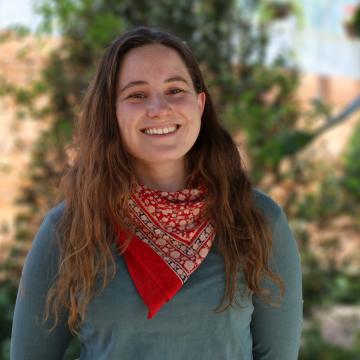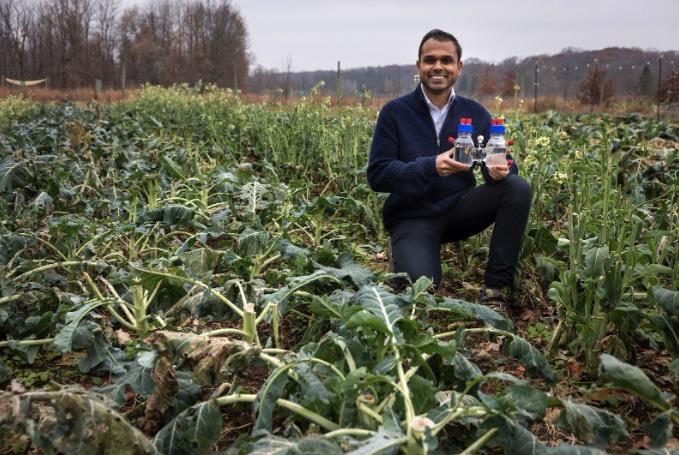
Photo caption: Dr. Joshua Jack, Assistant Professor in Civil and Environmental Engineering, holds the reactor at Campus Farm, 2025. Photo credit: MI Engineering.
What if food waste could be turned into jet fuel? Or transformed into the building blocks for new pharmaceutical discoveries? These are the questions Jack Lab is asking in their research at the Campus Farm. And they’re starting to get some answers - and they’re promising.
The project is part of the Living Learning Lab initiative from the Institute for Energy Solutions (IES) and is co-led across three units: Engineering, the School for Environment and Sustainability (SEAS), and MBGNA. IES defines Living Learning Labs as the use of real-world conditions and systems to inform research and education.
What a Waste!
In the US alone, we produce over 14 million tons of food waste annually. If the energy of that waste could be harnessed, it could heat more than 7 million homes, almost enough to power the entire state of Michigan.
The Reactor Remedy
Jack Lab is using a specialized electro-fermentation reactor at Campus Farm to find a sustainable solution, experimenting with technologies that can transform compost into a commodity.
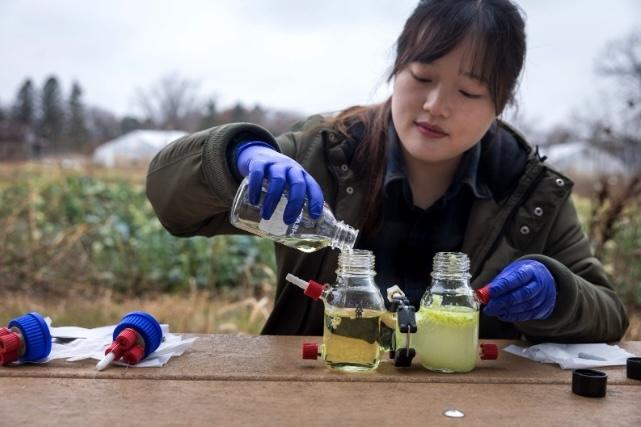
“Food waste is a persistent issue worldwide,” Dr. Jack shares. “As populations grow, we don't have a good way to handle it, but we're starting to see that technologies like ours can actually recover significant value for communities.”
If you hear the word reactor, towering nuclear plants might come to mind, but the reactor at the Campus Farm is no bigger than a basketball. It currently lives in a small shed on site. Most simply, the reactor uses electricity and microbes to transform waste into valuable chemicals. Typical composting processes produce methane. With methane's carbon footprint 80-90 times that of carbon, it’s not a sustainable energy source. And it's not economically competitive in US markets that have an ample supply of natural gas. Through the combination of specialised microbes and electro-fermentation, Jack Lab is exploring how the end product of waste digestion can be transformed into high-value fuels and chemicals that improve everyday lives.
Molecules with Merit
For the initial study, Jisu Yang, a PhD candidate in environmental engineering and the technical lead on the reactor, created synthetic food waste using cellulose, casein, and olive oil to mimic urban food waste. This first study demonstrated the ability to achieve high yields of caproic acid, a valuable six-carbon carboxylate (C6). This research is in the final stages of publication - stay tuned on the Jack Lab website to read the study in the next month!
“The C6 compound we made is actually a precursor for pharmaceuticals and jet fuels,” Dr. Jack explained. “And we were able to make it in large amounts in this initial study. That allowed us to say, okay, we demonstrated that this process works. Now we really need to understand how real food waste is processed in our system. That prompted this second follow-up study, where we're now doing a very similar process, but with all the complexity that comes with working with a real-world system.”
Real World Results
From these initial results, the collaboration with MBGNA and Campus Farm was born. The idea? Use the waste scraps from student-grown crops to demonstrate the efficacy of this technology in a real-world farming system.
Food waste doesn’t only occur post-consumer. Agricultural operations produce large amounts of organic waste called agricultural or crop residues before the product even leaves the farm. This organic waste accounts for more produce than the post-consumer pool, generating over 200 million tons per year here in the US.
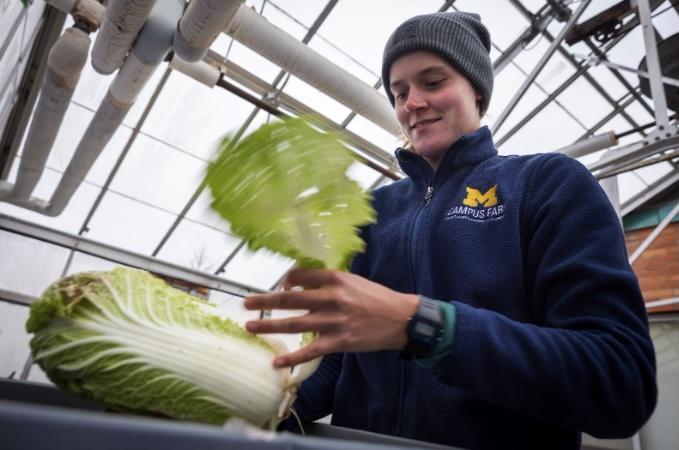
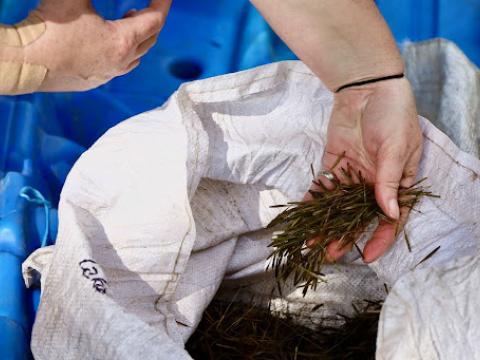
This waste is generated at large-scale, but also from smaller operations. For example, before Campus Farm's napa cabbage goes to the stand, the unseemly outer leaves are discarded. These leaves provided some of the initial organic waste for the reactor’s first“real-world” trials. Watch this short video to see the process in action.
These first trials with vegetable waste from Campus Farm provided exciting results. Real food waste, particularly lettuce, outperformed synthetic waste. “Looking at the literature, it has been among the highest ever recorded in terms of the amount of this C6 product we can make.” Dr. Jack shared. “So we're really at the leading edge. The potential for this technology is that we could make many different types of chemicals out of many different types of waste.”
Yang also shared a fun, unexpected finding.“When I'm running the reactor, the organic acid production usually produces some strong sour smells. But when we are using this fresh crop residue from Campus Farm, the sour smell is mixed with a fresh plant smell, so it makes the process less harsh than expected.”
Looking forward, the researchers plan to expand the types of waste they feed the reactor. In March, the reactor will be on display in the Temperate House, digesting compost from the fast-growing plants in the conservatory. This will give them an opportunity to see how the reactor processes waste from a broader range of species, such as banana and coffee leaves.
A Living, Learning Lab
The reactor's visible locations at Campus Farm and in the conservatory create opportunities to engage the public and train the next generation of students in sustainable practices through hands-on learning and translational research. “We're doing this in plain sight. The whole idea is to get as many people interested in and aware of our research as possible. Hopefully, we can reach a lot of people through this research.” Later this semester, Dr. Jack will bring students from his electrified processes course to the campus farm, where they can learn about the project and engage with the reactors hands-on.
Will it Really Work?
In tandem with the engineering research, a SEAS team led by Dr. Benjamin Goldstein is conducting a techno-economic analysis and life-cycle assessment, and modeling the electro-fermentation process. While the results haven’t yet been finalized, Dr. Jack shares that the preliminary findings are exciting. “We’re looking at this from different angles, and we’re looking long-term,” he shared.
Rebranding Rubbish
Beyond creating sustainable solutions, Dr. Jack and Yang hope the research will also transform public attitudes toward waste. As Yang shared, “I hope people could think differently about waste, not as something to discard or something useless, but as a potential resource.” Dr.Jack echoed this sentiment, lamenting the ‘ick factor’ that surrounds reuse and endorsing community involvement in science. “The idea of using materials that came from waste can be off-putting to some folks, but we have to overcome that stigma. And also inspire them to become excited about science! A lot of great researchers are driving innovation, not just for themselves but for their communities and for the broader world, and they dedicate their lives to pursuing the greater good. Science is interesting, it's strong, it's exciting.”