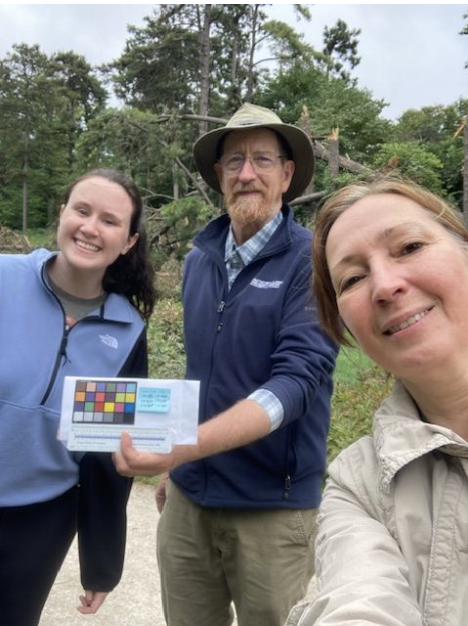
The W.E. Upjohn Peony garden is best known for its dazzling early summer blooms. Lesser known, this legacy garden is also a unique living laboratory for ongoing genomic research. An interdisciplinary set of collaborators, Visiting Research Scientist and Research Lab Specialist Dr. Nastya Vlasava, MBGNA’s Curator, Dr. David Michener, and leading Primatologist Dr. Liliana Cortés Ortiz in the Department of Ecology and Evolutionary Biology, work together to better understand the peony diversity held within the collection. The research is made possible in part through MBGNA’s sister-garden relationship with the Central Botanical Garden of the National Academy of Sciences of Belarus, which was established in 2015.
A Legacy Research Garden
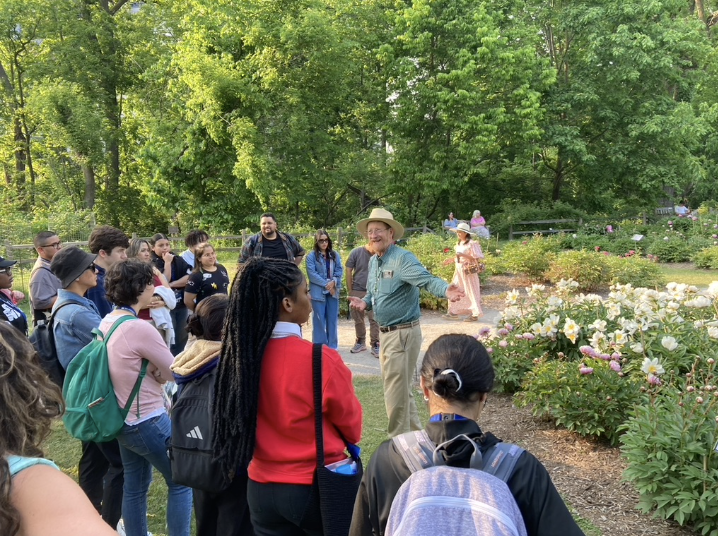
The W. E. Upjohn garden offers a unique landscape for research. “It didn't start as a research collection,” Dr. Michener shared, “But it's clearly become that. The plants are fundamentally in pairs, so it's a twin study, because they should be clones of each other. They've been sitting here for a long time. So one of the things we're very protective of is not introducing new environmental variables. We want to look at how the genes are expressed. It also addresses why we don’t just get rid of the plants that aren't blooming so well. We want to evaluate them before we just pitch them or decide that they're really worth keeping because they have part of the diversity that we're trying to capture.”
From Primates to Peonies
When Dr. Vlasava and Dr. Michener approached Dr. Cortés Ortiz about completing their genetic work at the EEB multi-user laboratory she directed, this relationship blossomed into a truly collaborative effort. “We soon found that my own background, which is studying primate evolution using genetic tools, was very applicable to understanding the genetic diversity of peonies,” Dr. Cortés Ortiz shared. In particular, her expertise in natural primate hybridization has been incredibly informative in designing studies to understand the origins and genetic pedigrees of peony cultivars. “We have focused on understanding the genetic diversity of the cultivars that we have here at the peony garden, which is important because these cultivars are unique. It is a historical collection, and so the diversity that is within these cultivars might not be representative of what it is now in the horticultural world.”
Plant Detectives
The project uses genetic detective work to better understand the ancestry of the cultivars in the collections. Unlike species that are wild-occurring and self-sustaining, cultivars are plants selectively bred for desired traits and propagated asexually, often through cuttings, so that each individual is a clone. Peonies, like many other cultivars, are the products of multiple generations of crossings among different species and cultivars. This work will help explain what crosses produced the peony cultivars present in the collection, how these cultivars are related to each other, and how closely. “We don't have any real sense of what part of the diversity we have, other than dates and names, and that's insufficient for a research institution,” Dr. Michener shared. “Many botanic gardens claim to have peony 'species', but when you look at the records, they've come from a nursery, or they were grown from seed from a grower, so there's no telling what they were hybridized with in the past, because the peony world, like most of horticultural works, goes by how does it look?” A plant’s true identity can be confirmed using genomic techniques. “There is a big disconnect on the kind of historical tracing of the origins of different cultivars to the actual genetic confirmation of their origin.” Dr. Cortés Ortiz explained. “And what is really interesting is that now we have the tools to look at these genomic or genetic markers that can tell us about the maternal lineage, and eventually we will work with others that can help us to determine the biparental lineages.”
Are You My Mother?
The first step in this work has been to tease out the maternal lineage using chloroplast DNA, as chloroplast organelles are passed down by the mother, making it easier to trace. “These sequences of the chloroplast DNA can allow us to distinguish different species,” Dr. Cortés Ortiz explained. “We use what are called primers that are specific for that region of the chloroplast DNA to make many copies of that part of the chloroplast genome, so we can actually sequence it. Then we use phylogenetic tools to compare across the different sequences and determine which sequences are more similar to each other, which means that those individuals probably share a closer ancestor in evolutionary time, and that's how we determine the species identity and the relationships between the different maternal lineages of the cultivars.”
Why Does it Matter?
Why is it important to know the true identity of these peonies? As Dr. Michener states, “You can't manage what you don't know you have.” Knowing the genetic fingerprint of each plant can help garden stewards better manage the collection and can enable conservation of the garden into the future. It can help understand which traits, like fragrance, color, size, or disease resistance, track across species, and how these plants might perform as environmental factors shift. “Ultimately, when I dream about our work with peonies, I want to get to the point where we can also identify genes that, combined together, produce a particular trait, let's say a color or a shape or the resistance to disease, and right now we are building up the foundational work to one day get to that point, ” Dr. Cortés Ortiz explained.
Viruses on the Scene
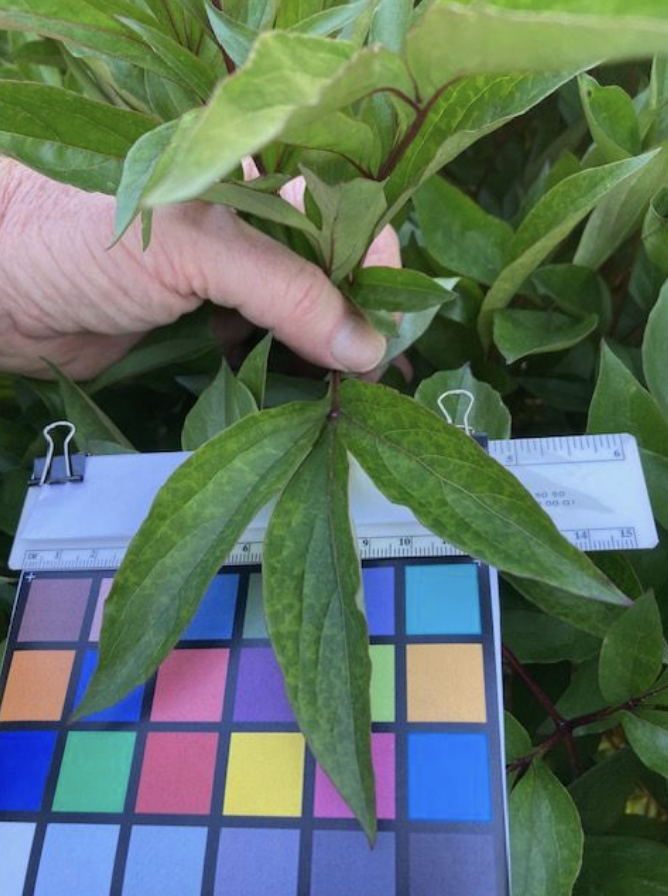
Understanding how disease resistance is inferred across cultivars has become increasingly relevant as viruses have appeared in the garden, and will only become exceedingly more necessary as climate change increases the risk and spread of viral pathogens. “We think we have identified at least five viruses on site, including coinfections of these viruses, which could have a much more severe impact on peony plant health,“ Dr. Vlasava shared. As the viruses have spread throughout the garden, some plants have fared better than others. “Something really interesting in the viral work is that even when plants might be proximate to each other, not all of them express the symptoms of the viral diseases.” Dr. Cortés Ortiz explained. “So definitely, we have plants that are more susceptible, and we don't know why. I think it will be a really interesting next step to understand whether genetic traits or ecological traits are associated with these differences in susceptibility. So those are very interesting paths to future research.”
Future Thinking in an Uncertain Present
As Dr. Vlasava shared, “Conservation, in a broad and long-term sense, is our goal.” But a rapidly changing world is putting both peonies and research partnerships into flux. Due to current political unrest, the sister garden partnership is currently on hold- but not withdrawn. “We're proceeding somewhat apart, but I think there's a great mutual awareness of what's going on as work is published, so it's not a competition, as much as it is different parts of the mosaic,” Dr. Michener shared. “We try to keep in contact and look forward to deepening and invigorating the relationships when we can.” The work continues, and the partnerships endure.