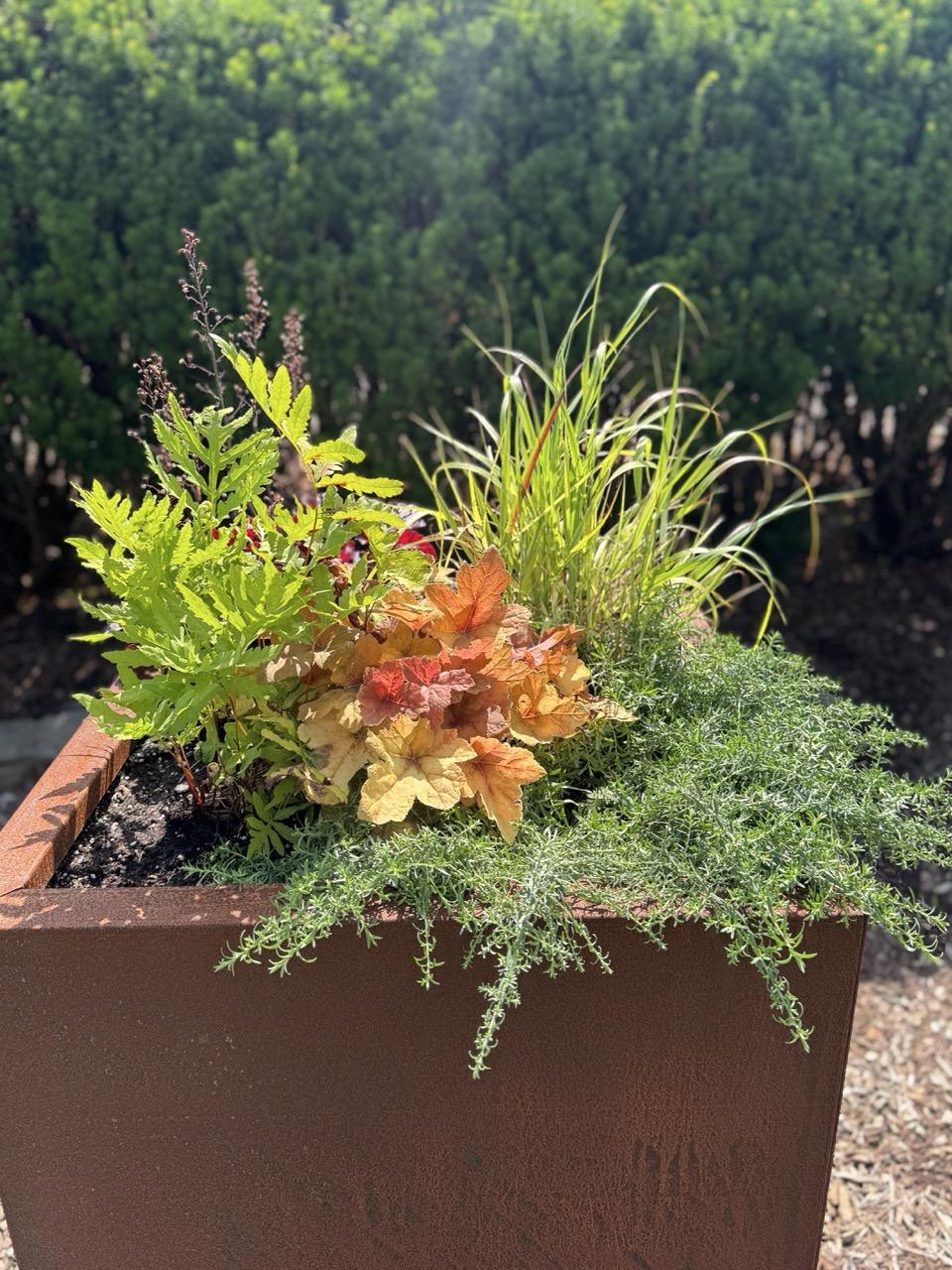
This planting combines Michigan native plants—including sensitive fern (Onoclea sensibilis) and cultivars of Michigan native switchgrass (Panicum virgatum 'Shenandoah') and heath aster (Symphyotrichum 'Snow Flurry')—with coral bells cultivars (Heuchera 'Pumpkin Spice' and 'Midnight Rose') derived from U.S. native species.
When people think of a formal garden, they often picture clipped hedges, neatly edged beds, and plants chosen for specific colors, heights, and bloom times. Native plants, by contrast, are sometimes seen as better suited to natural areas or informal landscapes because they are perceived as being messy or not showy enough. In reality, many native plants are just as well suited to formal garden designs.
A formal garden is shaped as much by design and maintenance as it is by the plants themselves. With thoughtful placement and routine care, many Michigan native plants can bring the same structure, texture, color, and seasonal interest as more traditional ornamental species.
This approach is becoming increasingly common in public gardens, where native plants are incorporated into carefully designed landscapes that are both beautiful and ecologically beneficial. At Matthaei Botanical Gardens, you'll find native species woven throughout our formal Perennial Garden, where they contribute to the garden's design while also providing food and habitat for pollinators and other wildlife.
Many of the same techniques used in traditional formal gardens, such as deadheading, edging, selective pruning, and the Chelsea chop, can also be used with native plants to maintain a more cultivated appearance. The result is a garden that looks intentional while continuing to support birds, butterflies, bees, and other beneficial insects.
Whether you're drawn to bold drifts of grasses, elegant foliage, long-lasting blooms, or carefully layered borders, there's likely a Michigan native plant that can help achieve the look you're after.
Native Plants for a Formal Garden
Part Sun to Full ShadeGroundcover/low growing:Wild geranium, Geranium maculatum: early bloomer with outstanding fall color Wild ginger, Asarum canadense: very low-growing plant with beautiful deep green foliage, makes an outstanding dense groundcover Creeping phlox, Phlox divaricatus: early bloomer fragrant, slow growing but eventually can form a small colony (this plant is a favorite of rabbits) Spring ephemerals: Instead of spring bulbs like tulips and daffodills many native spring ephemerals like blood root (Sanguinaria canadensis), Dutchman’s breeches (Dicentra cucullaria), spring beauty (Claytonia virginica), trillium species (source from a reputable nursery to ensure these are not wild collected plants) Alumroot, Heuchera americana or Bishop’s cap, Mitella diphylla: Both great low growing plants with beautiful foliage. Mitella prefers more consistently moist/rich soils, and has beautiful snowflake-like flowers Native violet species like yellow violet (Viola pubescens), cream violet (Viola striata), or common blue violet (Viola sororia). These plants typically are low growing with attractive foliage and flowers. Violas can act as a great groundcover and are a host plant for the specialist Fritillary butterfly! Textured foliage:Early meadow rue, Thalictrum dioicum: delicate foliage that has great movement in the breeze and emerges early in the spring Sedge species (Carex):
Showy blooms:Short’s aster, Symphyotrichum shortii: have to include an aster for a late season nectar source for pollinators. Blue/purple flowers can take part-sun too. This is about 3-3.5’ so a good plant to use in the back of the bed to allow shorter plants to still be seen Solomon’s seal, Polygonatum biflorum: One of the most elegant plants! Graceful arching stems with dangling white flowers. A European species is commonly used in gardens, but why not substitute the native one instead? Our native species is taller, so this would be placed in the back of a bed |
SunLow growing plants:Bottle gentian, Gentiana andrewsii: Outstanding late season bloomer! Flowers are a unique vibrant blue color and remain in a “closed” formation. Very well behaved in a garden setting and on the slower side to establish Nodding wild onion, Allium cernuum: Similar flower to ornamental varieties, but a shorter plant that is tolerant of moist to dry soils. Will self seed readily, but ornamental value is really high! Deadheading can be used to limit spreading. Cat's paw/pussy toes, Antennaria species: excellent silvery blue ground cover. Very low growing- ground hugging! Can form a mat, great in between pavers or in the front of the bed. Can be used as a petite alternative to Lamb’s ear Showy blooms:Foxglove beard-tongue, Penstemon digitalis: Many cultivars are used already in formal gardens, including our perennial garden. Very upright shape and blooms early in June, when many other plants aren’t quite going for it yet. Does self-seed. Wild columbine, Aquilegia canadensis: tolerant of so many conditions! Sun, shade, dry to average soils. Short-lived, so allow this to set seed. Pollinated by hummingbirds and very ornamental. Blooms early in the season Blazing-star species: There are quite a few species to choose from depending on soil types. Marsh blazing-star (Liatris spicata) is used in many ornamental gardens and likes wet to average soils. Marsh blazing-star is an upright perennial. Northern blazing-star (Liatris scariosa) needs well drained soil to dry soil. As a side note, Liatris scariosa can flop over if planted in rich/moist garden soils Blue lobelia, Lobelia siphilitica: late blooming blue flower on upright stem. Can be short-lived, but will self-seed if allowed. Tolerates wet to average soils. Butterfly weed, Asclepias tuberosa: Tough plant with beautiful orange flowers. Takes a few years to become established due to the taproot, but then extremely drought-tolerant. Likes well-drained to dry soils in full sun. Smaller in size, so great for the front of a bed. Host plant for the monarch butterfly Asters:
Black-eyed Susan, Rudbeckia hirta: June/July bloomer, commonly used garden plant with recognizable flowers. Upright shape, short-lived but will self-seed. Prone to powdery mildew so nice to mix into a dense planting- not as a large mass. Riddell’s goldenrod, Solidago riddellii: One of my favorite plants! Goldenrods get an unfair reputation. Most will self-seed, but because they bloom so late in the season they can extend the colors and interest in the home garden, plus the seeds are eaten by songbirds and the late-season nectar source is important for pollinators. Riddell’s goldenrod is very ornamental with large domed flower heads. This plant does get some nice fall color too. Likes wet to average soils and is taller, so use it in the back of a bed. Golden Alexander’s, Zizia aurea: Beautiful early blooming perennial. Will self-seed readily, host plant to the black swallowtail butterfly! Grasses/sedges: can be used in a mass to create drifts and to soften/fill in between other perennialsPurple love grass, Eragrostis spectabilis: dry, well-drained soils, creates a pink cloud when planted in mass Gray’s sedge, Carex grayii: moist to wet soils, the seed head is a spikey mace-like ball! Little bluestem, Schizachyrium scoparium: many cultivars are already used ornamentally; has an upright shape |