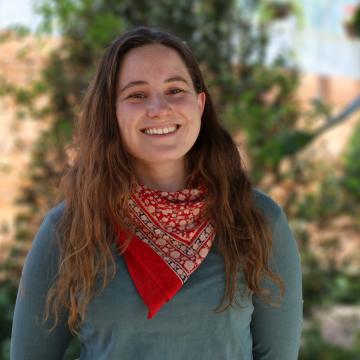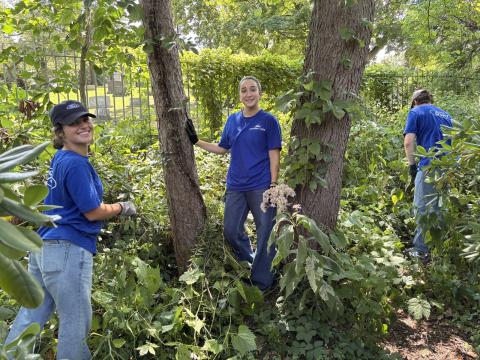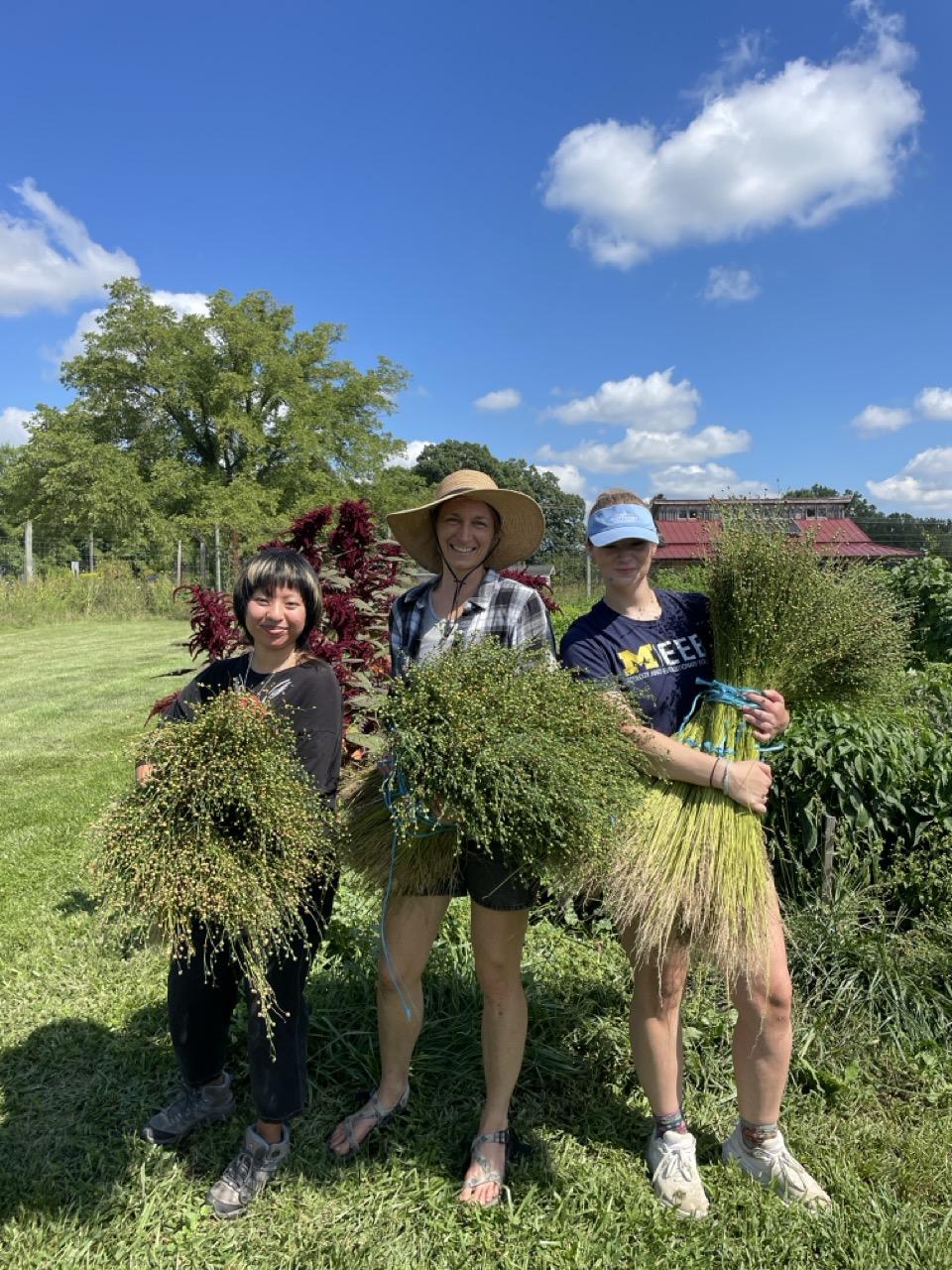
Angeline, Melissa, and Annie hold arm fulls of harvested flax plants.
This summer, ten rows of flax plants grew tall and vibrant green alongside a Campus Farm hoophouse. Planted by researchers in the Duhaime Aquatic Microbial Ecology Lab in Ecology and Evolutionary Biology (EEB), these plants are part of a larger statewide fibershed initiative.
“For the last decade or so, we've been studying plastics as a pollutant, thinking about what happens to them in the environment, and what their fate is. How are they degraded? Where do they go?” Dr. Melissa Duhaime shares. This work has involved documenting microbes that have the ability to digest plastic and studying plastic degradation over time.
Why would a microbiologist studying microplastic pollution be interested in growing a crop traditionally used to make linen?
As Duhaime shares, “I asked for some time what it would look like to focus my research more on supporting systems to replace plastics and the ways that we use them.” An analogy she uses is that her work started to feel like mopping up the bathroom floor instead of shutting off the tap on the influx of microplastics into the environment. “They are essential in many applications, especially biomedical and for supporting people with disabilities to live independently, and I can't imagine it would make sense to stop using plastics altogether—but we do need to think more holistically about the costs of their use."
Some industries are great contenders for plastic replacement. “I got really excited about textiles and the fashion industry because of how exploitative that sector is in terms of both labor and environment. As a country, we are exporting a lot of that exploitation, and so we don't bear their true costs.” Duhaime explains.
The fashion industry emits pollution in many forms, including GHG emissions, plastic fiber generation, toxic dye process byproducts, and microplastics released during production and wear. All told, the fashion industry emits nearly the same amount of carbon emissions as France, Germany, and the United Kingdom combined.
One obvious replacement for plastics and textiles is natural fibers. “And it's not innovation,” Duhaime explains. “It's returning to how things have been done since humans thought to wear garments as their first form of shelter. We've been making and wearing clothes from natural materials for millennia.”
That changed in the 1950s and 1960s, with the widespread adoption of fossil fuel-derived materials, like plastics, that could be produced inexpensively and were light and durable. Today, the majority of clothing made worldwide is synthetic.
The Michigan Fibershed is one of 43 groups supporting their bioregional natural fiber economies in the United States and 79 worldwide. Within a fibershed, garments flow through a ‘soil to soil’ model that follows fibers from where they're produced, either by animal or plant, through their processing, harvesting, dying, design, making, wearing, and rewearing, and then back to the soil.
“Eventually, the idea is, if there are no toxic compounds introduced to the garment in that cycle, you can return the material to the soil, those original carbon, nitrogen,n and phosphorous molecules, through composting processes and then start again,” Duhaime explains. “We started going on this journey to find out what it would look like to complete that cycle in Michigan.”
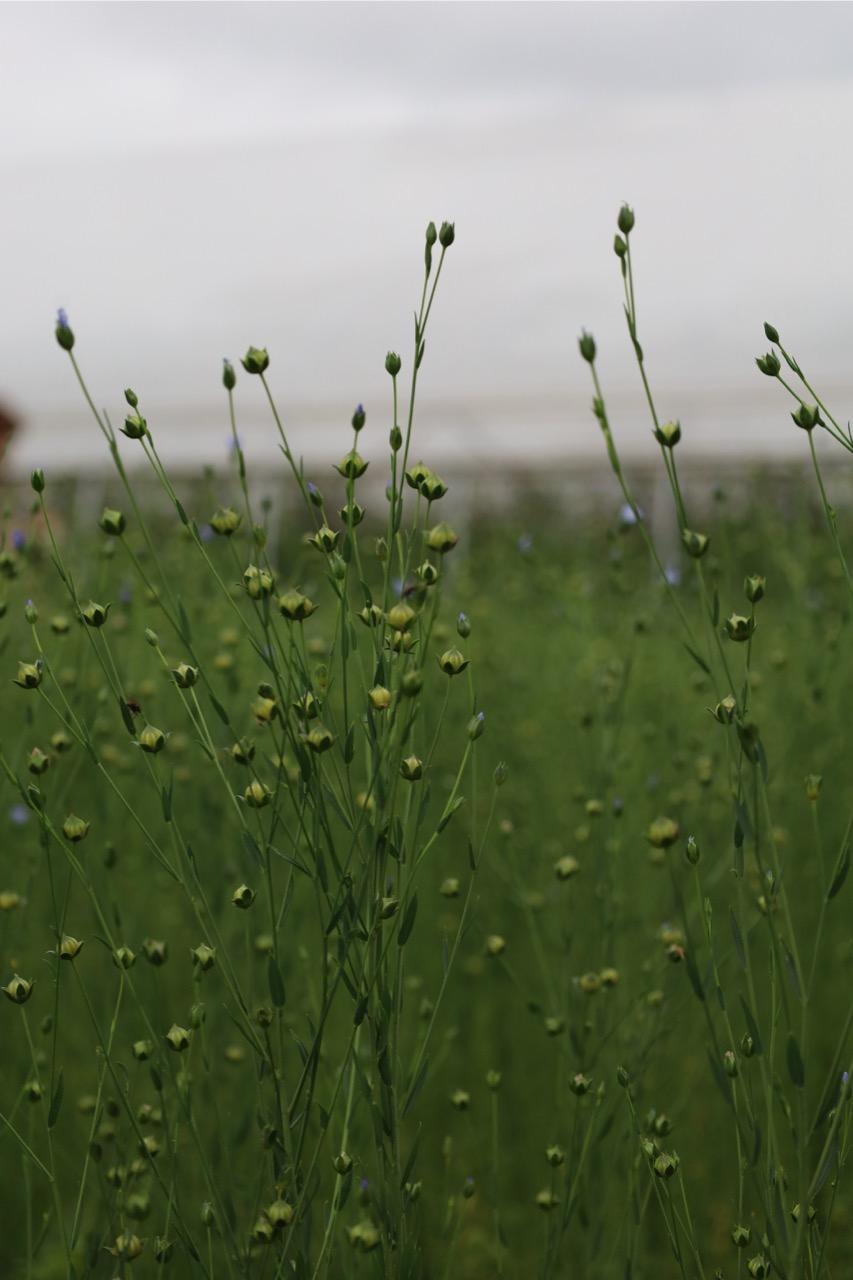
A century ago, flax was grown readily in the US for fiber production, including here in Michigan. Today, there is no flax-to-linen industry remaining in North America. However, it is still cultivated on a large scale in places like North Dakota and Minnesota for its seeds and oil. Varieties grown for flax oil have extensive branching on the plant to increase seed yield, resulting in shorter stems that aren’t ideal for fiber production. Long fibers are part of what makes linen so durable and long-lasting, and give it its beautiful sheen. Less common varieties in the U.S. grow tall without much branching, making them ideal for extracting the fibers to produce linen.
Researchers in the Duhaime lab are conducting trials to determine which varieties thrive best in Michigan's climate, aiming to create data that supports the expansion of flax farming for fiber. Eight of the varieties are grown from seed from the PA Flax Project, a group in Pennsylvania that works to reestablish flax production infrastructure. This project has imported flax varieties from France and the Netherlands. Two other varieties come from “FibreRevolution,” another group working to revitalize flax production in Oregon. “You kind of have these like hot spots where the industry is being revitalized and new life and energy brought to it.” Duhaime shares.
Annie Wesorick, a research assistant responsible for data collection, has spent the summer measuring plant attributes, including height and capsule number, and monitoring the plants throughout their growth stages. “Most of my data has focused on height and how long the flax stems are, because the flax stems are where the fiber will come from.”
While the research team isn’t yet at the analysis stage, Annie's preliminary observations indicate stark differences in the growth of the different varieties. “We grew ten varieties, and they all grew in different ways. I definitely know a lot about the specific varieties and their niches, just from being in the garden so often.”
Angeline Tran, an art and design student, volunteered on the project, also helping with data collection at Campus Farm.
They have been involved with the fibershed for the past few years and are interested in supporting the circular textile economy. “If I want this type of system to exist, I also have to put my effort towards it, to sustain it.”
Angeline emphasizes the role of relationships in the success of the fiber shed. “The fibershed, it only happens because of relationships, and it transforms the relationships along the way, between people, and also between people and how they consume and move through the world.”
What can you do to help diminish microplastic pollution and support your local fibershed? Duhaime encourages starting by examining the tags on your clothing before you make a purchase. “I wish more people thought for a moment about what the contents mean for both where that material came from, and what it means to wear that material close to their skin. The skin is the largest organ of the body, and it is super permeable. There's very, very little regulation about clothing.”
Angeline invites people to learn to mend. “I think buying more sustainably is a good step, but it doesn't really change the relationship with clothes. If you invest in a skill like hand sewing, it does take time, but it's a good practice.”
Annie echoes these calls, sharing that her role has deepened her appreciation for sustainable fashion and natural fibers. “This project has made me realize the amount of work that goes into making a garment, and making a garment sustainably. I would encourage people to think more about their consumption habits and question everything they buy a little bit more.”
If you are interested in getting involved with Michigan Fibershed, sign up for their newsletter to stay updated on upcoming events and opportunities to contribute.