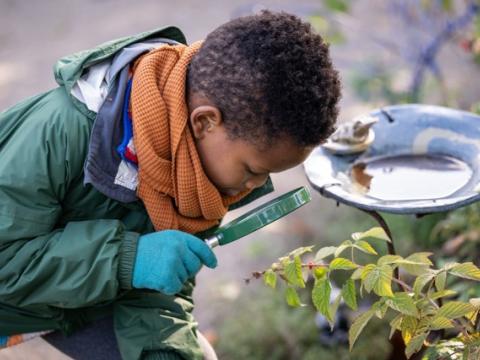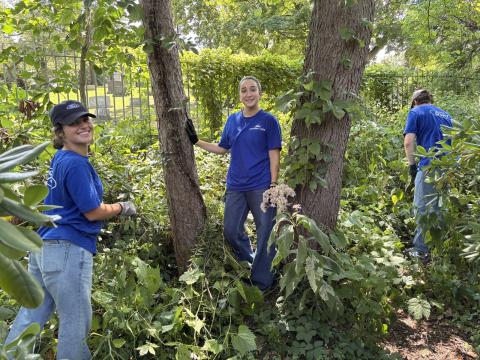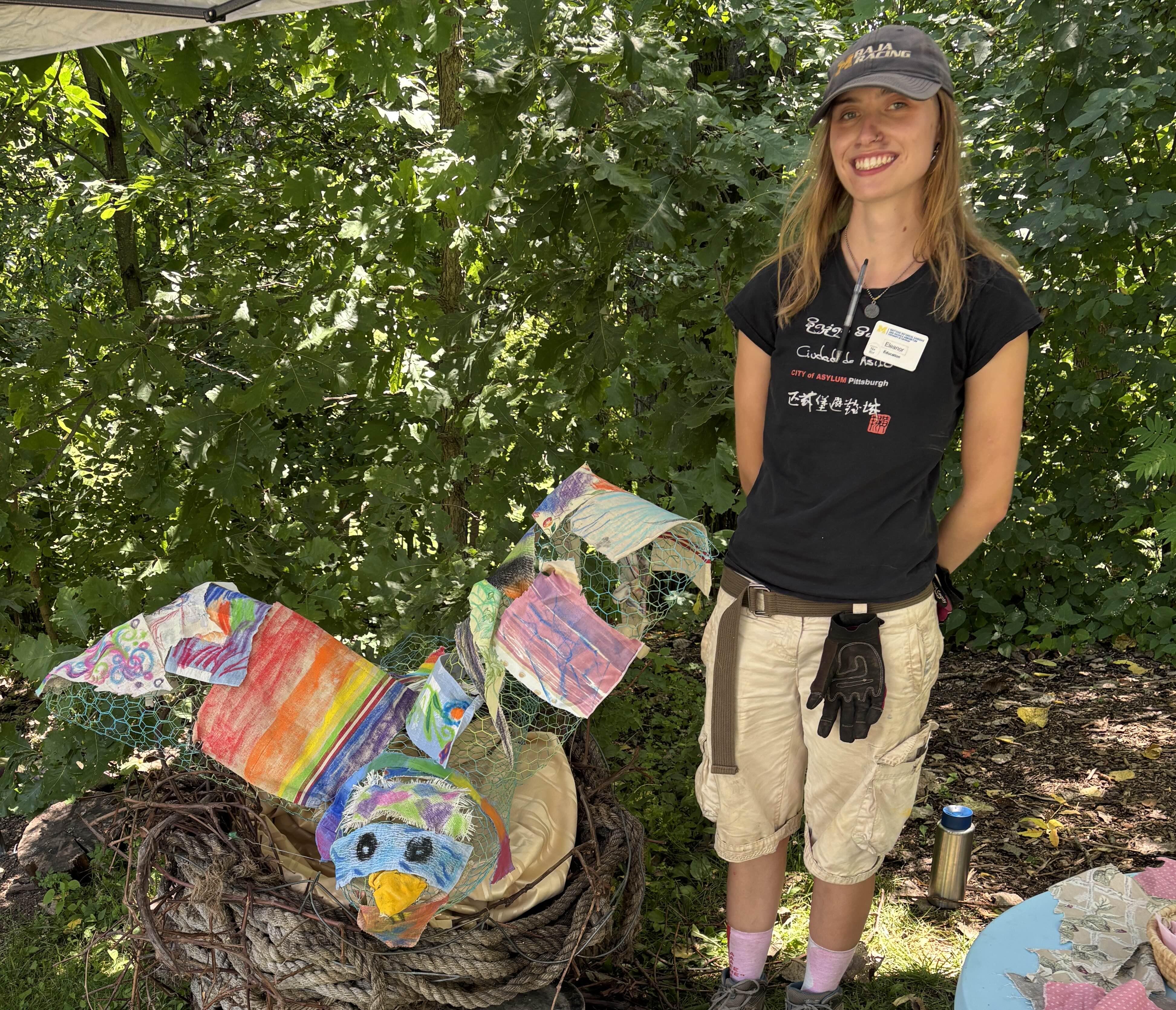
This summer, Eleanor Mulgrave Schlick joined MBGNA as an intern, tending the Gaffield Children’s Garden and learning firsthand what it means to steward a living landscape. In her reflection below, Eleanor shares how the work has reshaped her way of moving through the world, where learning happens not in textbooks, but in the soil, through the senses, and in the everyday rhythm of care.
Two weeks into my summer internship tending a section of Matthaei Botanical Gardens at University of Michigan, I realized that my normal methods for archiving life would not apply to this experience. I didn’t crave words, but some other artistic medium to describe what a day of work feels like. But, all I really know how to use is words, so what resulted was a circumlocution of alternative forms of expression:
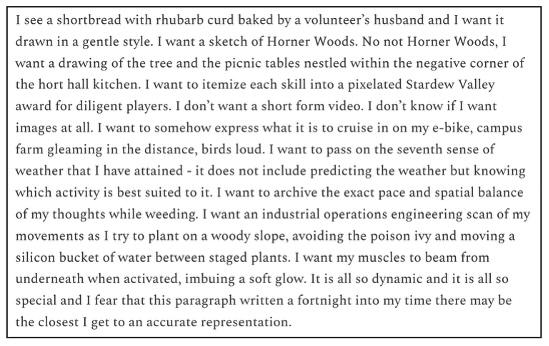
Before this point, I lived the academic life, which for college-inclined 21 year olds, is the default life. The academic life meant my body moved predictably in classrooms, coffee shops, and gyms. Default movement in a default life made the transition to an environment that demands varied, novel movement shocking. Straight-shot walks along familiar streets to the lecture hall became a 7-mile-long wooded bike ride to a sprawling set of gardens. I had entered a different world, but not as a mere visitor, rather a steward. “Look, don’t touch” signs do not apply to me.
To care for a natural environment, means to be in perpetual physical contact with it. I share responsibility for the Gaffield Children's Garden, which contains crop beds, swaths of flowers and sedges, a trail in the woods, and an abundance of naturalistic play infrastructure. To learn how to plant, weed, water and prune all these jurisdictions, I did not study formally. It was May and we had to get the plants in and the paths mulched before Memorial Day weekend. Because botanical gardens are governed by the seasons and summer internships typically start in late spring, we had no time to read horticultural texts. The only appropriate thing to do was to start with field work. I struggled to express my experience at the gardens with words, because I was undergoing learning that is not achieved textually, or even orally.
When I first arrived, my supervisor would explain how deep to plant a seed, but that is not where the learning occurs. The learning occurs when you feel how small and gentle they are on your hand and how easily they get lost in the dirt, leaving you wondering where to plant the next one. I am aware of taste, sight, sound, hearing and touch in new and distinct ways, but more than that, the sensory information is immediately relevant to the task at hand. It is not sense for sense’s sake, but sense for the sake of engaging effectively and appropriately with my environment. In my rapid account of ways to express a day at work, I was trying to demonstrate the minimal distance between perception and action, to allude to the context that made being physically in-tune an essential part of doing my job well.
The corporeal nature of learning to care for a garden is embodied most explicitly in life-long horticulturalists, who can not help but weed regardless of where they are or what they are doing: the hand plucks a seedling of its own volition, the shovel-knife is pulled faster than a gun in a duel, and the invasive woody falls before the handsaw-wielding expert informs you of the victim’s identity. A true environmental steward is not someone who observes nature from afar, but someone fundamentally attuned to their immediate surroundings. The type of stewardship engaged in is not entirely independent of human intention –to re-wild, to produce food, to create a look– but if you want that intervention to be effective, the person implementing it needs to be aligned with the natural area as it is. Every morning the other intern and I did a sweep of the garden, and a month into the experience, we stopped needing words, because our whole selves, mind and body, knew what to do with whatever information the space offered us that day. There was no need to study, because everything required to caretake existed in our perception and the garden itself. More than that, I didn’t feel compelled to codify the meaning of my experience with writing. The significance of the work does not lie in this piece or any of my notebooks, it lies in the ground and all that grows from it and the people who come to explore what we have stewarded.
For a more in-depth exploration of the concepts that made this articulation possible such as nature play and ecological psychology, please refer to Eleanor’s newsletter “A working knowledge of living” at https://eleanorms.substack.com/