May is when many gardeners start thinking about new spaces, fresh plantings, and how they want their gardens to take shape for the season ahead.

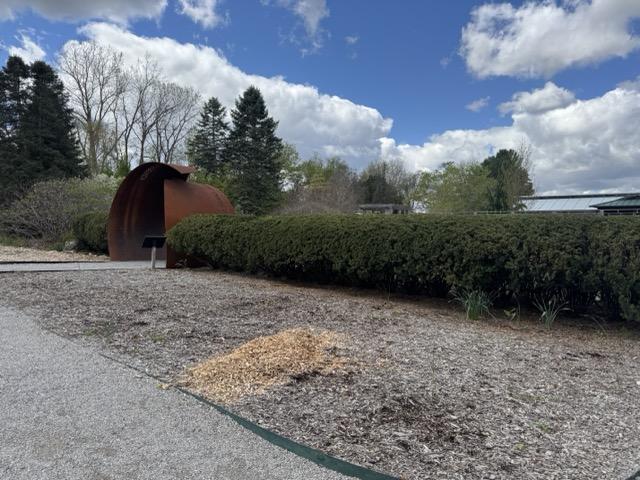
We sat down with Kayla Vaccaro, a master’s student at SEAS studying landscape architecture and a member of MBGNA’s horticulture team. Her work at MBGNA includes both caring for display gardens and contributing to new on-site design projects, including a garden she designed near the Herb Garden and Perennial Garden. The space is currently a mulched site and will be planted this summer with support from MBGNA interns.
We spoke with Kayla about the fundamentals of garden design for home gardeners starting from scratch.
When you begin designing a garden, what’s the very first thing you consider?
The first thing I think about is site conditions, especially light, moisture, and drainage, since those really determine what can live there. I like to visit the space and pay close attention to the broader context: what’s around it, how the light moves through it, and what’s already present. All of that helps ensure whatever I design feels cohesive with the existing landscape.
For a home gardener starting from scratch, what’s a simple way to think about layout before choosing plants?
It really depends on what’s already there. Starting from scratch can feel overwhelming because you have so many options, so I usually begin with structure, especially woody plants. If you’re attached to a particular shrub or tree, you can anchor your design around that. For example, designing around an oak tree immediately starts to narrow your plant palette and decisions.
When I’m laying things out, I don’t draw every plant in detail. I sketch in loose shapes, almost like blobs or simple forms, like a lollipop for a tree or a mound for a shrub. That helps you feel the balance of the space. You can start to see if one area feels too heavy and where you might need lighter perennials to even it out.
Texture also plays a role. You might want finer textures in the front where you can really notice them, or use them as a backdrop to something more bold and dense.
And you’re always thinking about how the space will be used. If I’m designing around a path or a patio, I place heavier elements in a way that defines the space and makes it feel more enclosed, comfortable, and “held in.”
Expanding the season of interest is often a key goal for gardeners. What does that mean in practical terms?
It’s really about thinking through seasonality - thinking about bloom time, leaf color, and how the garden changes over time, not just at its peak.
One of the simplest ways to do that is to make a basic spreadsheet with plants listed in rows and months across the top as columns. From there, you can mark key moments like peak bloom or fall color with an “X,” or even fill in cells with a representative color if you want something more visual. It’s a quick way to see whether everything is happening at once or if you’ve created something that carries interest through the full season.
When you’re selecting plants, how do you balance aesthetics, function, and maintenance?
I think the most important thing is “right plant, right place, right purpose.” Just choosing things that are actually going to thrive in the conditions you have, and that work together ecologically.
Grouping plants in threes or more usually looks best - single plants can feel a bit awkward on their own. There’s something about repetition that really helps create cohesion.
And starting with structure kind of guides everything else. Once that’s in place, color, texture, and seasonality can all layer on top of it and help tie the design together.
What’s a realistic way for home gardeners to match their design to the time they actually have?
Some plants definitely need more attention than others. Groundcovers are a very important layer of any planting design, especially low-maintenance ones; once they get established, they form a dense natural mulch that helps suppress weeds. Perennials are a really good option as they get established, filling in space and coming back every year.
And honestly, starting small is key. Just focus on one area, see how it goes, and build from there. Doing a bit of research or talking to experts at a nursery up front is really worth it too, especially to avoid plants that end up being too aggressive or spreading more than you want.
If someone is standing in their yard right now, not knowing where to start, what are the first 2–3 steps you’d tell them to take?
Start by thinking about places you’ve really enjoyed being. Look at photos of those spaces and even trace over them to get a sense of the shapes and layout. It’s often the arrangement more than the specific plants that makes a space feel good.
Spend some time in your own yard too. Notice what you see from inside, where you naturally want to be, and how the space feels. You can even stake things out and just sit with it for a while.
And then start small and build from there.