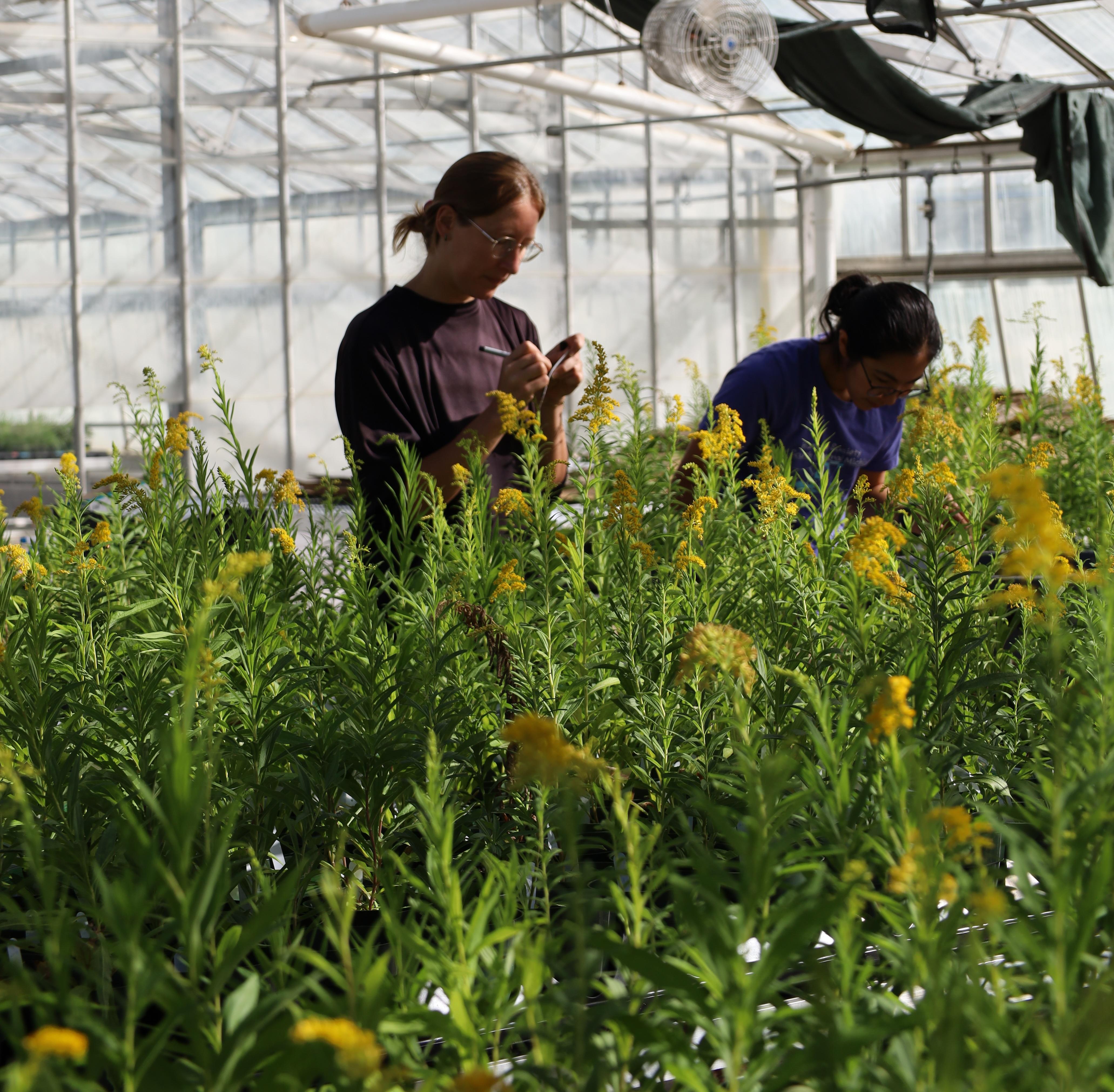
Dr. Julia Eckberg (left) and Dr. Mia Howard (right) working together to harvest goldenrod plants from a greenhouse experiment.
If you visit Matthaei Botanical Gardens in early Autumn, you’re bound to see yellow fields of goldenrod stretching across the landscape. In Greenhouse 2, there are also fields of goldenrod, smaller, and all growing in orderly pots. A widely abundant native plant, goldenrod makes a great study species for plant ecologists.
The Howard lab, led by Dr. Mia Howard, assistant professor in Ecology and Evolutionary Biology, uses the greenhouses at Matthaei as a site for plant ecology research.
“We're interested in how plants interact with insect herbivores and microbes in the soil, and the consequences of that for ecology and evolution,” she shares. While plants may seem helpless, rooted in place and unable to escape, it doesn’t mean they’re defenseless. “Before I took a plant biology class in college, I had always liked plants, but I thought of them as passive background organisms that were pretty or gave us food,” Dr.Howard explains, “But I didn't really think of them as being active and alive and doing things to protect themselves against the things that wanted to eat them.” Plants can defend themselves in many ways, from spines, thorns, and leaf hairs to bitter compounds and toxins. These plant defenses come with a price—they are often nutritionally expensive, requiring the plant to invest a lot of energy in their production.
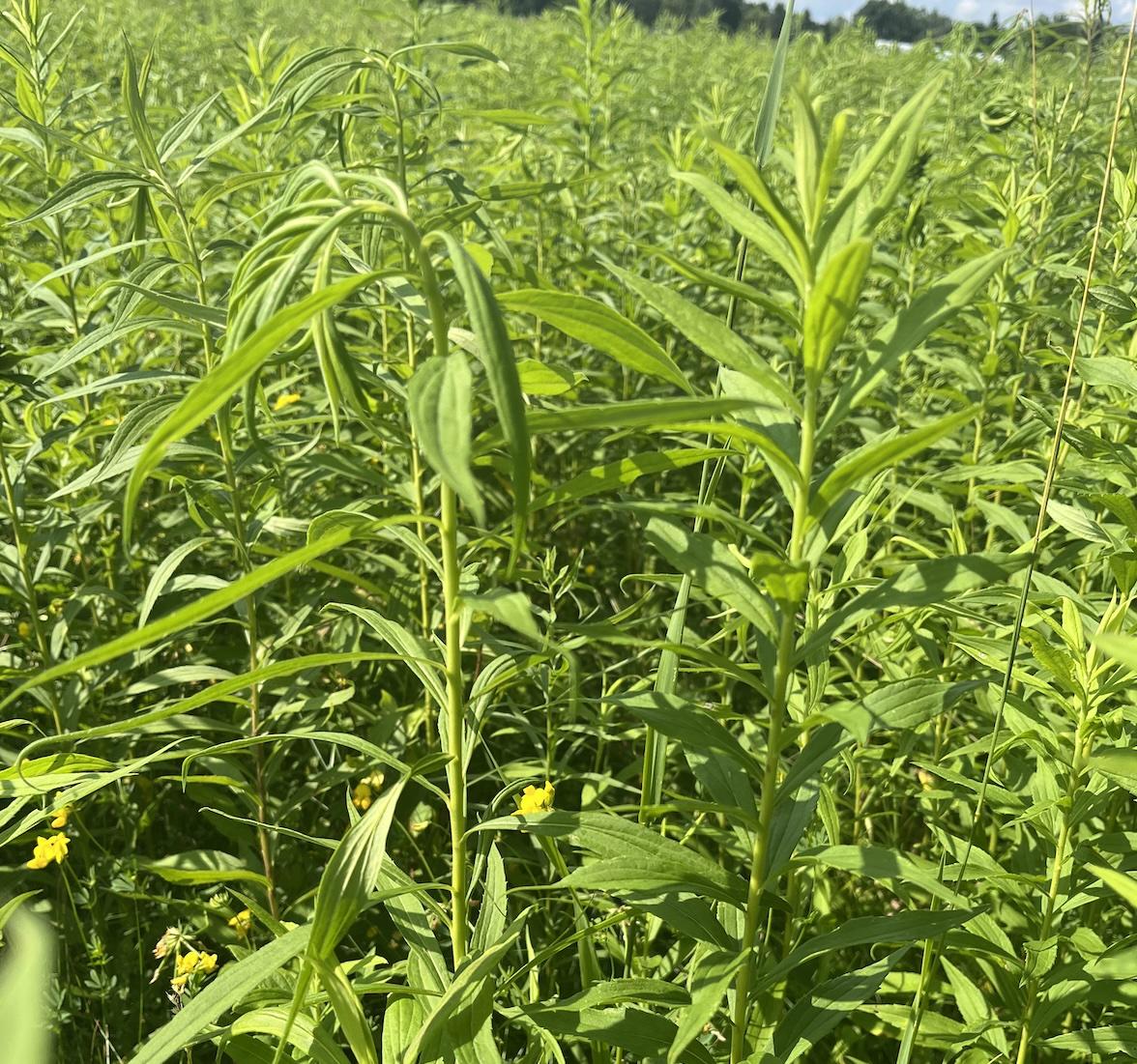
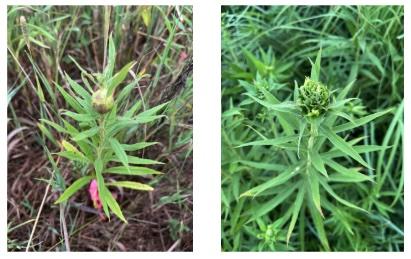
One defense goldenrod uses is “stem nodding,” a temporary defense mechanism thought to protect the plant from insect pressure. In spring, goldenrod is threatened by gall-forming flies and midges that lay eggs in developing plant stems. Once laid, it alters the plant’s physiology, forming galls that look like balls or layered leaf “rosettes” to house its developing larvae. During the season when the insects are active, some goldenrod plants bend the tops of their stems, protecting themselves from infection.
The Howard lab is interested in better understanding how soil nutrient levels in a system can influence the evolution of plant defense strategies, such as nodding. A recent study from the lab suggests that nitrogen availability in a system can drive plant defense evolution. The study used legacy research plots at the W.K. Kellogg Biological Station at Michigan State University, which have been enriched with agricultural levels of nitrogen since the 1990s. Researchers compared stem nodding prevalence in tall goldenrod (Solidago altissima) growing in historically fertilized plots to that in plots with ambient nitrogen levels. The results indicate that abundant nitrogen increases the likelihood that plants will evolve this defense mechanism.
“One thing that I think is really exciting is that we're seeing evolution in plants on a pretty short time scale,” Dr. Howard explains. “Many people view evolution as a process that occurs over hundreds and thousands of years. But here we had a treatment that was 30 years long, and we're seeing the evolution of defensive traits on that kind of timescale.”
Now, the lab is interested in how else nitrogen might impact plants on both evolutionary and ecological scales. Using plants collected from the plots at the Kellogg Biostation that have been acclimatized to the greenhouses at Matthaei, Dr. Howard and her lab are applying treatments to these plants to ask more questions, now in a controlled environment. A postdoc in the lab, Dr. Julia Eckberg shares, “We have this unique microevolutionary timescale where we can investigate how nitrogen fertilization might shape plant resistance and tolerance to herbivory.”
One treatment is the addition of contemporary nitrogen fertilizer to half of the plants to compare the long-term versus short-term effects of nitrogen on plant traits and performance. “We’re wondering, if a plant is fertilized with nitrogen, is it more important how much nitrogen is available now, or is the history of nitrogen availability more important?” Dr.Eckberg explains. In another treatment, Dr.Eckberg simulated herbivory by cutting the leaves and spraying them with jasmonic acid, a plant defense hormone. This treatment allows the researchers to examine the induced defenses, those increased by herbivory. It also allows the researchers to examine how tolerant these plants are to herbivory. As Dr.Eckberg explains, “Tolerance to herbivory is essentially how well a plant recovers after being chewed on.” Tolerant plants can withstand herbivory and continue to grow and reproduce effectively. “We’re interested in whether these different nitrogen evolutionary histories and nitrogen fertilization affect how tolerant these plants are to herbivory,” Dr. Howard adds.
A second experiment, led by graduate student Hanna Petroski, is examining the evolutionary effects of nitrogen on plant-on-plant competition. In these experimental plots, goldenrod is grown alongside big bluestem, another native prairie plant. “If there's a lot of nitrogen in the environment, plants tend to grow faster and taller, which will increase competition with other plants for resources such as light and other nutrients. So plant competition is another major plant ecological interaction, besides herbivory, that's going on in these plots. Goldenrod also produces some chemicals in its roots that are thought to be allelopathic, meaning they inhibit the growth of other plants. That's also something we're going to look at to see if this long-term nitrogen fertilization has affected the evolution of this chemical trait.”
Goldenrod’s abundance and ecological importance aren’t the only appeal of this study species - its ability to dominate ecosystems offers broader learning opportunities. “Goldenrod grows really effectively in these dense monocultures, which is how we grow many of our crops. From an applied standpoint, there's a lot we could learn about how these plants grow so well in these giant monocultures and don’t get decimated by insects or diseases.”
While goldenrod can get a bad reputation for its wild growth and the false belief that it causes fall allergies, Dr. Howard encourages keeping this native plant in your garden. As Howard explains, goldenrod is an insect-pollinated plant with heavy, sticky pollen that is not easily carried by the wind. Ragweed is the more likely culprit for your stuffy autumn nose. And while it may grow rangy, its benefits make it worth keeping; goldenrod is a keystone native species that supports an abundance of pollinator specialists.