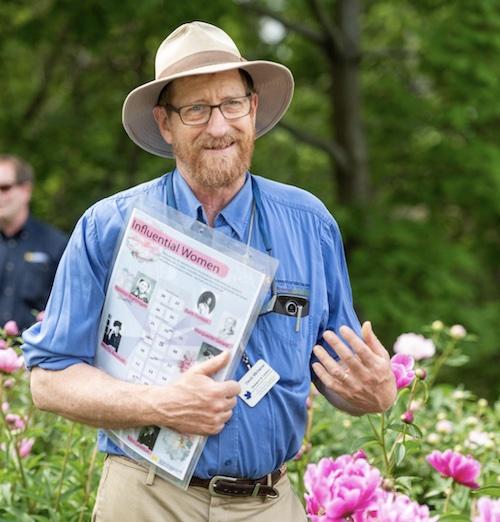
David Michener, PhD, has spent decades helping shape the W.E. Upjohn Peony Garden into one of the most significant public peony collections in North America. Recently honored with a Lifetime Achievement Award from the American Peony Society, Michener sees the recognition not simply as a personal milestone, but as acknowledgment of a much larger effort: restoring, studying, and reimagining what a university peony collection can be. In this conversation, he reflects on the garden’s revival, the challenges of preserving living collections, the role of research and mentorship, and the enduring wonder he still finds in peonies after decades of working among them.
You were recently honored with a lifetime achievement award from the American Peony Society. What did that recognition mean to you, and what do you feel it reflects about your career?
First, I think it’s premature. But I also think the award recognizes something larger than me personally. Here at the W.E. Upjohn Peony Garden, we’ve been working to revitalize peonies in the American public imagination and to show that public display gardens can also be serious research collections.
I think that’s really what the recognition reflects: promoting peonies through public institutions while also asking bigger questions through research. Most people tend to do one or the other. We’ve tried very hard to do both.
This award recognizes a lifetime of work with peonies. What has that work actually looked like over time?
The effort to revitalize what’s now the W.E. Upjohn Peony Garden goes back long before me. In the 1970s, people in the community, especially members of the Women’s National Farm and Garden Association here in Ann Arbor, realized the collection was in danger of being lost. For decades, all that really happened was mowing. The beds weren’t even clearly defined anymore. It was basically a lawn with peonies coming up through it.
There were many different attempts over the years to stabilize it, but the major rejuvenation effort began in the late 1990s under Bob Grese, together with Linda Cody and others, asking: how do we actually make this work long term?
The challenge was moving the peony garden from simply being a beloved display garden, a pilgrimage site for many people, into something with a clearer role within the University. How could it become a collection that engaged students, supported research, and still remained meaningful to the public?
Part of that work involved building a broader framework around the collection. We assembled a peony advisory team with specialists from the American, Canadian, Minnesota, and Wisconsin peony societies to help re-identify plants and assess the collection. That’s also when Carmen Leskoviansky was first hired specifically as a peony specialist. Adrian O’Brien also worked heroically with Carmen on records and restoration work.
At one point, we also discovered serious disease and virus issues in the collection. We removed plants from the back four beds and went very far down the rabbit hole trying to control the spread. One year, we were sterilizing tools between every single plant. Eventually, we realized we were being reactive rather than realistic, and that many of the problems we were trying to control were already decades too late to contain in any meaningful way. That process fundamentally changed how we thought about the collection, not just as a garden display, but as a living system linked to evolving best practices in research, cultivation, and long-term stewardship.
My role in all of this has probably been less about vision and more about strategy: how do you build the case that a research university should care about a peony garden? What makes a collection sustainable inside an academic institution? This is where my 20 years of service on the Rackham Graduate School’s Museum Studies faculty steering committee gave me profound insights into parallel museum-centered discussion, definition, and resolution - why re-invent the academic relevancy wheel?
This meant connecting many different pieces together: public engagement, research, student involvement, museum studies, records management, statistics, genomics work, internships, and donor support. We studied why so many academic peony gardens in North America disappeared after World War I and realized many failed because there wasn’t a coherent institutional reason for them to survive.
So part of the work has been helping legitimize the collection from multiple perspectives at once.
Are there particular moments in the collection that feel like milestones to you?
Absolutely. One milestone was simply the persistence of community members from the 1970s through the 1990s who refused to let the collection disappear. Without that sustained local advocacy, it probably would have been lost.
Another major moment was forming the advisory team and beginning the difficult process of re-identifying the collection. Once you start treating something as a serious collection, details matter. Earlier, during what I sometimes call the “citizen phase,” if there was an empty space in a bed, people would simply divide another peony and fill the hole so the garden looked full. But if you’re trying to maintain a documented collection, you can’t just have five copies of one plant where there should be two, and others that should be included are not there.
The disease investigations first proposed by Visiting Scholar Dr. Vlasava were another turning point, even though they were difficult. In some ways, that disruption also opened opportunities. When plants had to be removed from the back beds, it created a kind of reset that eventually allowed new projects and partnerships to emerge, including the Pee for the Peonies initiative.
I also think an important milestone was realizing the garden could operate simultaneously in many different worlds. It could be a beloved public landscape, but also a place for graduate students in statistics, information science, museum studies, genetics, and environmental fields to ask meaningful questions.
You’ve spent much of your career at the Matthaei Botanical Gardens and Nichols Arboretum. How long have you been here, and what has kept you?
I came here in 1990 after six years as a National Science Foundation postdoctoral researcher at Harvard’s Arnold Arboretum.
At the time, Matthaei and the Arboretum were still separate institutions. My early work focused much more on the conservatory and public horticulture projects. The peony collection became a larger part of my work later, particularly after the institutions were unified administratively.
Honestly, when I first arrived, I assumed I would only be here a fairly short time before moving somewhere else that seemed more structurally coherent. But one of my personal mantras is “bloom where planted.” When people buy plants at a nursery, they don’t buy them because of theoretical potential; they buy the ones already doing something well.
I’ve always thought academic life works somewhat similarly. You work with what you have, and you try to make things stronger and more meaningful over time.
What kept me here was the possibility of building things. Not just gardens, but systems and relationships that connected public life, scholarship, collections, and education.
How do you think about your connection to the generations who built the collection before you?
Over time, I’ve developed a real humility about why earlier generations chose the plants they did.
What’s here exists first because people thought these peonies were beautiful. They grew well in this climate. They smelled wonderful. They represented the best cultivars of their era.
Today, we may also think about collections in terms of documentation, genetics, preservation, or research value, but originally, many of these choices were rooted in aesthetics and horticultural excellence. That deserves respect.
The eras change, though, and part of our work now is building additional layers of meaning around the collection while still honoring the earlier intentions behind it.
The peony collection is widely admired, but it’s also a research resource. What makes it significant beyond its visual impact?
One important thing is that peonies allow us to ask questions people don’t necessarily expect from a garden collection.
We’ve worked with graduate students in statistics to look at flowering patterns and historical assumptions about bloom timing. We’ve collaborated on records and database systems with students from the School of Information. There’s ongoing work involving genomics and plant health. Questions about disease management alone became incredibly complex.
And part of what changed our thinking is that you stop looking at it as short-term, individual plant maintenance. You begin to see it from an ecosystem perspective, across decades, even centuries of material moving through the collection. Once you do that, the questions are just different.
At the same time, the collection also raises broader cultural and institutional questions. Why do collections survive? Why do they disappear? How do universities justify maintaining living collections over long periods of time?
So yes, the peonies are visually spectacular—but the collection also functions as a long-term laboratory for thinking about public horticulture, institutional stewardship, and research itself.
You’ve mentored many students and colleagues over the years. How do you approach mentorship?
Mentorship is really important because it’s the future. What matters is helping people develop a sense of trajectory, understanding what’s important, while also recognizing that they’ll need to interpret these things for their own time, just as we’ve interpreted them for ours.
I don’t think mentorship is about saying, “This is how it’s done.” It’s more about saying: these are the issues, these are some of the tools, and everything is going to keep changing. People need to be able to make judgment calls.
So to me, mentoring is about helping people develop enough experience, depth, and perspective to make future decisions that are coherent with the broader trajectory, but not limited by what we know now.
In other words: take it your own way, but do so knowingly. That’s the liberating part of it.
When you think about the future of the W.E. Upjohn Peony Collection, what do you hope continues or changes?
On the research side, one thing I really hope is that we come to better understand the peony diseases that are present in the collection. That’s an important area where there’s still a lot to learn. There’s also some very interesting work in developmental biology that peonies could help illuminate. Peonies do some really strange things biologically, and I’d love to see more collaboration with developmental biologists and possibly even people at the medical school around some of those questions.
For the public-facing side of the garden, I hope every space is occupied by thriving plants, and that the tree peony collection fully complements what’s already here. But there’s also a larger curatorial question we’ve been thinking about. Historically, we defined the collection as peonies introduced before 1950, partly because we needed some kind of decision framework. But time moves on. Fifty years ago is now the 1970s, and there are cultivars from the 1960s and 70s that are becoming historically important in their own right.
So part of the future is asking: what do we preserve, and why? Some peonies are beautiful and historic, but also extremely common in collections everywhere. Do we need multiple examples of those, or should we make room for newer historic cultivars that help tell a broader story? That’s a conversation we have been exploring through networks of botanic gardens and the American Peony Society.
I think the next generation will help move that thinking forward. Rather than a fixed historical cutoff, the collection becomes more of a moving target, something periodically reviewed and reconsidered. But it’s still grounded in a trajectory that comes from the historic core established by Dr. W.E. Upjohn. That continuity matters; it’s not starting over, it’s building from something already intentional. And because peonies take years to mature, you have to think long-term and evaluate carefully over time. We’re now in a position where we can build much stronger performance records, too: which cultivars thrive, which flop over, which are resilient, which struggle.
And beyond all of that, I’d love to see the collection become even more connected to the arts and humanities. There are connections to literature, visual art, opera, medicine, cultural history—especially Chinese, Japanese, and Korean traditions, where peonies occupy a very different cultural and medicinal role than they do in the United States. To me, that’s part of what makes the collection exciting. Every direction you look opens another path of inquiry.
After a lifetime working with peonies, what still surprises or delights you?
I still love the foliage colors that emerge in spring. Some of the oranges especially—I still don’t fully understand where those colors come from biologically, and I love that there are still things that feel mysterious.
And then there’s the fragrance. Some of them have a scent that I can only describe as joyful. There’s still a real sense of delight in encountering that each season.
But honestly, one of the greatest pleasures is watching other people experience the garden. I’d even call it a kind of transcendent joy—seeing people slow down, seeing families, students, patients, visitors all responding to the flowers in their own ways.
One of the reasons the peony garden is so important is its proximity to the hospitals. Not everyone who comes through the garden is here as a tourist or a plant enthusiast. Some people are carrying enormous stress or grief. And the garden offers something different for a moment—beauty, fragrance, memory, surprise, calm. I think that matters very deeply.
What continues to amaze me about peonies is that they keep opening outward into more questions. There’s the horticulture, the genetics, the history, the art, the cultural meaning. Every direction you look, there’s another path to follow.