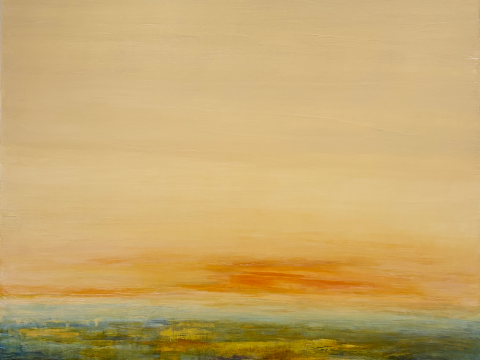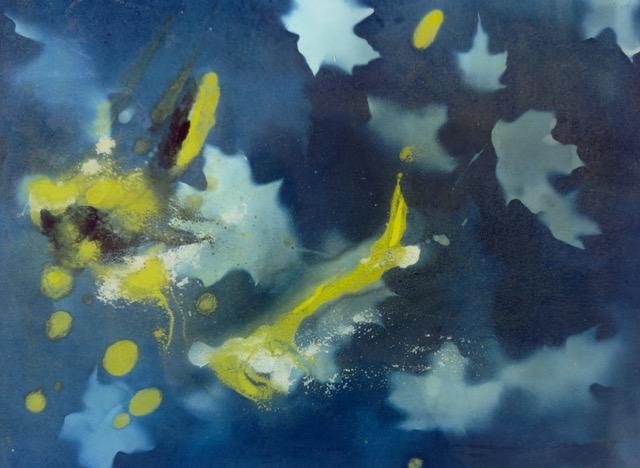
Through painting, printmaking, and mixed media, Leslie Sobel explores the interconnected systems that shape forest ecosystems. Drawing on field research, scientific collaboration, and her work as a Michigan Naturalist, Sobel highlights keystone species—from white oaks to beavers—and the often-unseen relationships that sustain life both above and below ground.
Blending materials like encaustic, cyanotype, and found-object assemblage, the work invites a closer look at the complexity—and beauty—of the natural world, with the hope of deepening connection to the environments we depend on.
May 2 – July 19, 2026
Closing Reception: July 19, 2026, 2–4 PM
Free and open to the public at Matthaei Botanical Gardens.
Artist Bio
Leslie Sobel is a painter, mixed media artist and printmaker whose work has been exhibited widely in galleries and art centers throughout the United States, including; Stand4 Gallery, (Brooklyn, NY); The Belle Isle Conservatory (Detroit, MI), Nurture/Nature Center (Easton, PA), 22 North Gallery (Ypsilanti, MI), WomanMade Gallery (Chicago, IL), The University of Michigan (Ann Arbor, MI) and many more
Sobel has been awarded a number of grants and awards from The Michigan Council on Arts and Cultural Affairs, The Puffin Foundation, Puffin Foundation West, Wright Ingraham Institute, the Ohio Arts Council and others. She has attended many artist residencies, including three residencies in collaboration with Susan Hoffman Fishman. (Planet Labs, San Francisco, CA; Five Points Center of the Arts, Torrington, CT and The Swimming Hole Foundation, Bearsville, NY). The residencies enabled them to plan and execute their collaborative projects, Flood 2.0 and In the End, a Devastating Beauty. Flood 2.0 resulted in a traveling installation in 2023 and 2024 at the Five Point Gallery (Torrington, CT) and the Ely Center of Contemporary Art (New Haven, CT); The exhibition, In the End, a Devastating Beauty, took place in 2024 at Stand4 Gallery, in Brooklyn, NY.
Sobel’s individual practice has focused on the impact of climate change on ecosystems and bodies of water especially at the high latitudes for more than 20 years. She has attended two residencies in the Arctic Circle, taught climate scientists in Alaska and camped on an ice field with glaciologists in Yukon Territory as well as a teaching residency at the University of Michigan Bio Station. Sobel’s work often incorporates scientific data as well as imagery ranging from photo-microscopy (she has brought a field microscope to many locations) to satellite imaging. Her work ranges from very large format encaustic monotypes and other mixed media to intimate mixed media assemblage.
Sobel’s partnerships with scientists have led to a deep understanding of the interconnectedness of ecological systems. She uses her extensive range of media to best elucidate those connections. In 2024 she became a Certified Master Michigan Naturalist, deepening her understand of many facets of Michigan ecology.
Articles, interviews and reviews of Sobel’s work have appeared in Art Spiel, Detroit News, The New Art Examiner, Seed Broadcast’s agri-Culture Journal, Arts Paper, New Haven Independent, Artists and Climate Change and numerous others.
Sobel holds a Bachelor of Fine Arts from the University of Michigan in Ann Arbor and a MFA from the University of Hartford in Hartford, CT. She completed coursework for a masters in Technology Management at Eastern Michigan University in Ypsilanti, MI.
Artist Statement
This exhibition developed from my teaching residency at the University of Michigan Bio Station in 2023 and my subsequent training as a certified Michigan Naturalist as well as my residency in the Upper Peninsula of Michigan this past summer. I have long been deeply interested in our interconnected ecosystems. My love affair with trees started in childhood but has more recently grown as I’ve learned more about how trees communicated through mycorrhizal networks underground. The pieces in the conservatory aim to make visual what happens both above and below ground.
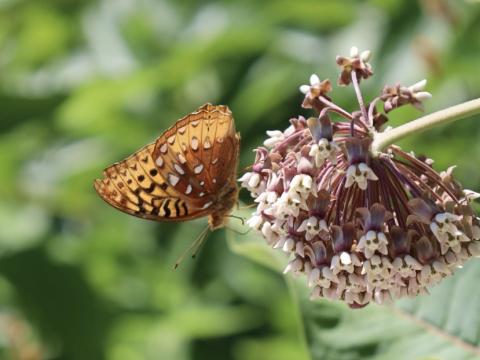
On the walls are a set of encaustic and cyantotype pieces exploring leaves and branches as well as mixed media shrines - in found boxes, utilizing metal leaf and pigment to highlight the key species that make a functional, interconnected ecosystem. Keystone species are those that an ecosystem requires to function. Some are animals like beavers - the consummate engineers of wetlands and streams whose impact on MBGNA has been very dramatci since they returned. Some are plants like the white oak which provides food and habitat for 400 other species. Pollinators including birds and insects will be a key part of these pieces - with the very tiny blown up to a size that makes their details clear to the observer.
My aim with this project is to educate people about the importance and connective nature of our home ecosystems. I deeply believe people don’t take care of environments to which they lack an emotional connection. To that aim I showcase my love for these environments by capturing elements which are compelling, important and beautiful - and portraying them in ways that convey understanding as well as love.
Funding for this project has been made possible by The Puffin Foundation, Ltd.